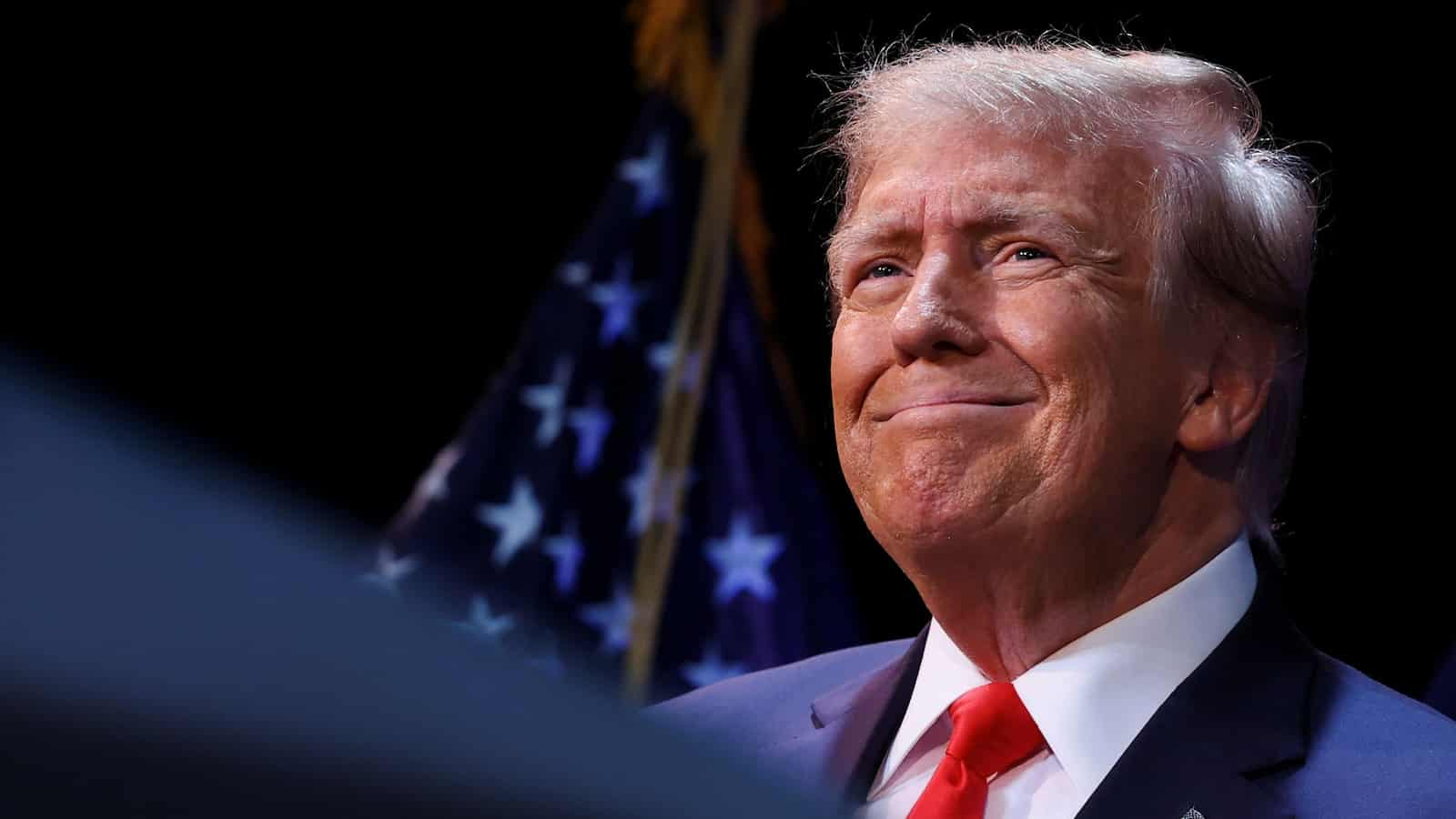
Trump’s Tariffs: This week, President-elect Donald Trump took to Truth Social to announce plans for a 25% tariff on goods from Canada and Mexico, which are major trade partners of the U.S. He expressed concerns about crime and drug trafficking, claiming that thousands of people were crossing through these countries, causing an unprecedented surge.
Trump also emphasized that both Canadian and Mexican governments had the ability to quickly address this issue. Until they did, he said the tariffs would go into effect immediately when he took office.
The U.S. gets a large share of its crude oil from Canada, and imposing tariffs on these imports could have a direct impact on drivers, as the additional costs would likely be passed on to consumers.
Who is Tom Homan and What Has Trump’s ‘Border Czar’ Said About His Deportation Plans?
The U.S. Energy Information Administration (EIA) reports that Canada’s crude oil imports reached a record 4.3 million barrels per day. This oil is refined in the U.S. and sold to consumers and businesses. In fact, these imports make up about 50% or more of the total crude oil supply in the United States.
How drivers could be impacted by tariffs on Canadian oil
We expect U.S. #refinery capacity to be 17.9 million barrels per day by the end of 2025, about 3% less than at the beginning of 2024.
We expect refinery margins for #gasoline and #diesel will remain relatively unchanged in 2025. #STEO
▶️ https://t.co/UJpbEuOfod pic.twitter.com/5CKiFWEzHE
— EIA (@EIAgov) November 15, 2024
In 2023, the U.S. spent about $124 billion on crude oil imports from Canada. If a 25% tariff were placed on Canadian oil, U.S. importers and refiners would have three options. First, they could reduce imports so the total cost, including the tariff, stays around $100 billion, resulting in a lower supply of crude. Second, they could keep imports the same and pass the 25% tariff cost onto consumers. Third, they could maintain import levels but absorb some of the tariff cost, sharing part of it with consumers. Fuel prices would likely increase.
In the first scenario, reducing supply with constant demand would push prices up. In the second and third, the price increase would depend on how much of the tariff cost importers pass to consumers. According to the EIA, gas prices in 2025 are expected to average $3.20 per gallon. If the full tariff is passed on to consumers, prices could rise by $0.80 per gallon.
If Trump and his team assume that prices won’t rise because of increased production and refining capacity, they fail to consider that infrastructure would need to be built, and that refining capacity isn’t expected to grow next year.
Even if tariffs manage to bring jobs back, something many economists are skeptical about—it will take time, and in the meantime, consumers are likely to face higher prices.
The Real Reason Donald Trump is Boosting Cryptocurrencies
But it’s not just about bringing jobs back; it’s also about ensuring they are good-quality jobs with fair pay, decent working conditions, and benefits. When Trump talks about “Making America Great Again,” many people, especially white men who see him as a way to restore the dignified lives their fathers and grandfathers had, often think of these kinds of jobs.
— Donald J. Trump Posts From His Truth Social (@TrumpDailyPosts) November 26, 2024
The death of American manufacturing
During President Bill Clinton’s administration, the normalization of trade with China took place, building on the groundwork laid during President Nixon’s time. In 1995, when the World Trade Organization (WTO) was established, China gained full membership.
This shift occurred during a pivotal historical moment: the collapse of the USSR, which led many U.S. policymakers to believe that America faced minimal foreign competition.
According to AS News, many manufacturing jobs in the United States were outsourced to nations with lower labor costs in the years leading up to China’s WTO entry. Today, only 7% of American workers are involved in manufacturing, down from over 20% in 1979. Significant economic effects have resulted from this reduction, especially for the workers who depended on these occupations.
This shift has created severe economic hardships, especially for workers without college degrees, many of whom, according to NBC exit polls, supported Donald Trump and his promise of economic revival through tariffs on key trade partners.
The outsourcing of manufacturing jobs had a devastating impact on communities across the U.S. Factories shut down, incomes dwindled, and local businesses were forced to close, with no new investments stepping in to fill the void.
This economic decline overlapped with the opioid epidemic, which worsened as years went on. In 2000, the CDC reported fewer than 20,000 overdose deaths; by 2023, that number had skyrocketed to 107,543. The economic distress Trump highlighted during his campaign was not a sudden development; rather, it had been building for decades.
A Failed Economic Vision
President-elect Trump’s rhetoric on trade struck a chord across the country, driven by widespread dissatisfaction with decades of trade policies under both parties. Alan Greenspan, former Chair of the Federal Reserve, acknowledged mistakes after the 2008 Financial Crisis.
Vivek Ramaswamy’s Staunch Support for Trump’s Immigration Policy
A student of Milton Friedman, Greenspan advocated in the 1980s and 1990s for transitioning the U.S. from a manufacturing-based economy to one focused on services and “innovation.” Over the years, this shift took root, with the proportion of U.S. workers in the service industry rising from 65 percent to 75 percent.
But this change left a void for workers who could have been employed in manufacturing or the logistics that supported domestic production.
While some argue that the new jobs in services were better than those lost in manufacturing, the metrics tell a different story. Labor force participation has dropped compared to thirty years ago. Since 1995, median real wages, adjusted for inflation, have grown by only 0.7 percent annually, a modest 17 percent increase over 24 years.
These meager gains have not significantly enhanced workers’ purchasing power. Meanwhile, wealth inequality has worsened.
The top 50 percent of households now own 97.5 percent of the country’s total net worth, up from 96.6% in 1995, while the bottom 50 percent’s share has dwindled from 3.5 percent to 2.5 percent. Is this a record that Democrats or Republicans want to champion? Over three decades, the workers who drive the economy, the bottom half, have been left with less.
The False Promise of Outsourcing
Outsourcing has allowed corporations to keep wages relatively stagnant over the past three decades while selling cheaper goods. This strategy has enabled consumers to purchase more than they could have when these goods were produced domestically. However, the benefits of this model have been unevenly distributed. The top 1 percent of households saw their share of total wealth grow from 26.5 percent in 1995 to 30.2 percent in 2024. For those at the bottom, the costs of globalization have been glaring: doing more with less, while witnessing a growing concentration of wealth at the top.