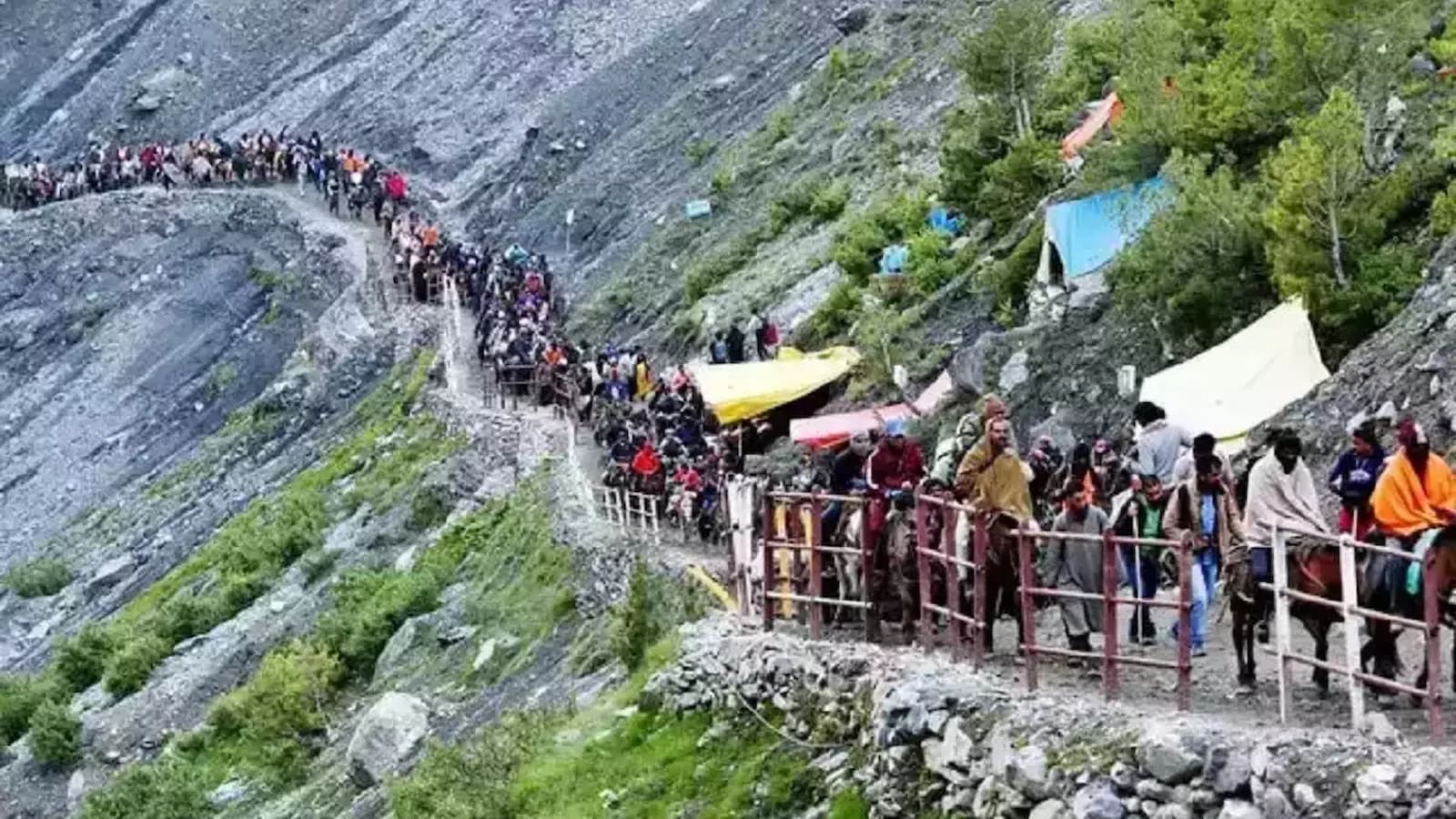
Amarnath Yatra Landslide Risk: A new study has warned that large parts of the Amarnath pilgrimage route in Kashmir could face landslides due to heavy rainfall, steep mountains and weak rocks. The research says human activities such as road widening and construction are also making some areas more dangerous.
The study was published in the international journal Scientific Reports on November 10, 2026. It examined the Baltal-Amarnath Cave-Panjtarni-Poshpathri route in the upper Sind catchment of the Kashmir Himalayas.
According to the findings, 16.2% of the surveyed area falls under the high landslide risk category. Another 68.1% is at moderate risk, while only 15.7% is considered low risk. The findings matter because lakhs of devotees travel through this mountain region every year to visit the holy cave during the Shri Amarnath Ji Yatra.
Made-in-India Renault Kiger Gets 4-Star Global NCAP Safety Rating: Check Scores And Features
Study Finds Rainfall and Weak Rocks Behind Landslide Risks
The researchers recorded 49 landslide incidents along the route. These included 28 debris flows, 15 rockfalls, two debris slides, two rockslides, one creep zone and one rock topple. Around 71.4% of these incidents happened in areas with high landslide risk.
The team studied 18 different factors, including slope, height, soil, rock types, drainage, vegetation and distance from roads. Their model received an accuracy score of 0.80 during training and 0.86 during testing.
Heavy rainfall is another major concern during the pilgrimage season in July and August. Snow cover drops to around 6% in July and just 0.4% in August.
The research recorded 54 days with extreme rainfall of more than 45 mm in the Baltal Valley between 1994 and 2024. Fifteen of these events happened during the monsoon season. The study also found that 60-70% of landslides happened within 50 metres of roads or other disturbed areas. Road cutting and construction can make already weak mountain slopes even less stable.
Rising Temperatures Add to the Problem
The researchers used India Meteorological Department records from Pahalgam between 1980 and 2024. They found that the average yearly temperature increased by around 0.05°C every year.
Snow cover also changed greatly. It measured 77.03 square kilometres in 2018 but fell to 24.86 square kilometres in 2020. The researchers said changing temperatures can affect snowfall, soil moisture and water flow.
However, the study doesn’t blame climate change alone. It points to a mix of weak rocks, heavy rain, steep slopes and human activity.
Uttarakhand Gets November 20 Deadline to Submit Kedarnath and Badrinath Reconstruction Work Report
The number of pilgrims has also increased. Around 3.60 lakh visited in 2022, followed by 4.45 lakh in 2023 and 5.12 lakh in 2024. The number was over 4.14 lakh in 2025 and around 4.8 lakh in 2026.
Researchers Suggest Steps to Make the Yatra Safer
The study has recommended several steps to reduce the danger for pilgrims. These include improving drainage systems, building retaining and gabion walls to support weak slopes and planting trees such as willow and birch near streams.
The researchers have also advised authorities to check the geology of an area before building or widening roads. Temporary tents and other facilities for pilgrims should be moved away from dangerous slopes to safer ground.
The report further recommends updating landslide risk maps every 10 years. Regular monitoring through satellite images, LiDAR technology, weather reports and ground checks can help improve early warnings. The researchers have also called for better emergency planning and a national database to record landslides.
The research was carried out by six experts from India and Japan. They belong to the Geological Survey of India, National Institute of Hydrology, IISER Mohali, Lovely Professional University and Hiroshima University. Riyaz Ahmad Mir led the research work, while Md. Omar Sarif from Hiroshima University was the corresponding author.