
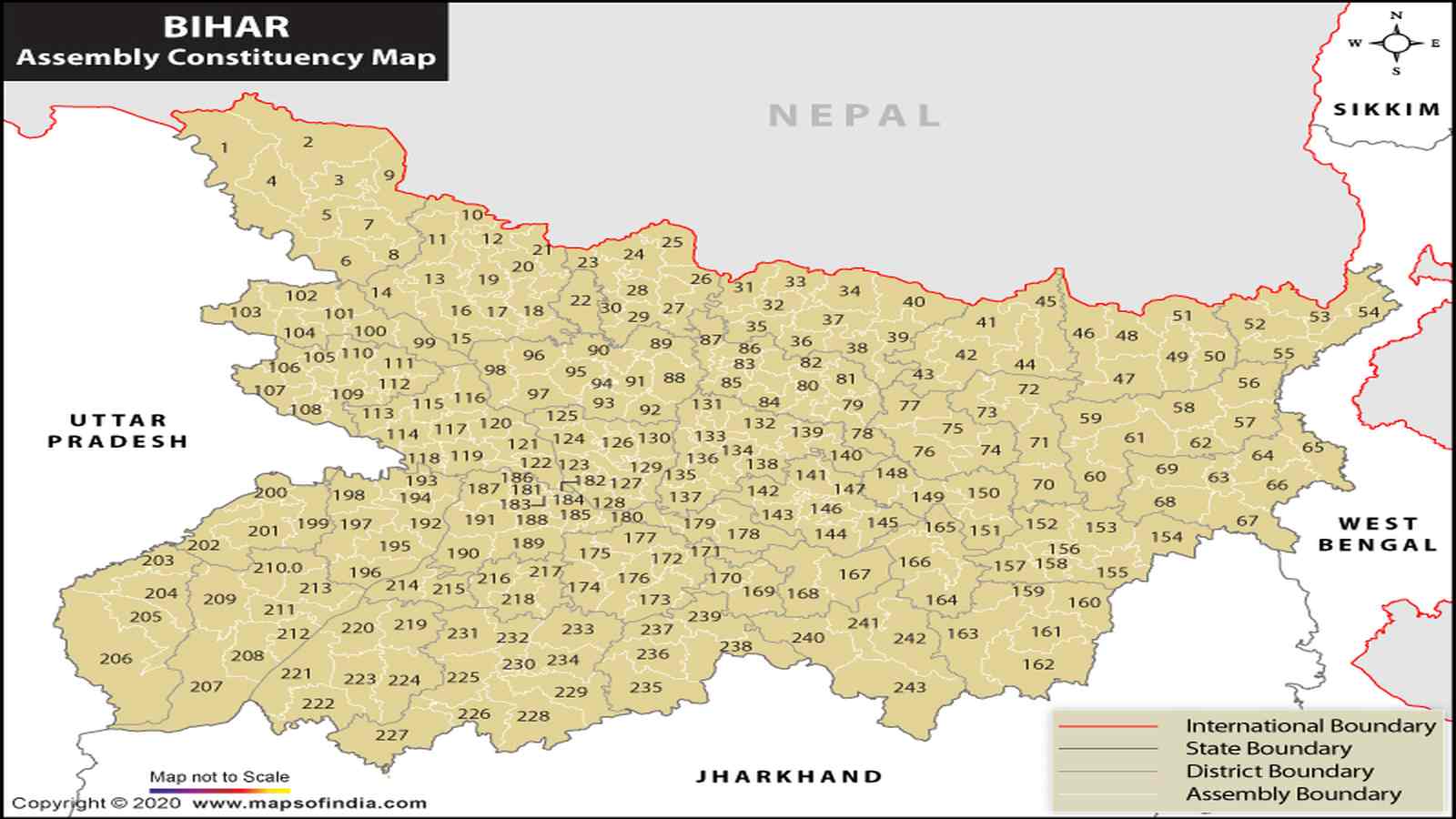
Benipatti Assembly Constituency 2025: Benipatti is a Legislative Assembly constituency (No. 32) located in Madhubani district in Bihar, forming part of the Madhubani Lok Sabha constituency. Its composition, after delimitation in 2008, includes the entire Kaluahi community development block plus 26 gram panchayats of the Benipatti block: Bishunpur, Basaitha, Behata, Bankata, Pali, Parsauna, Dhagjara, Barhampura, Akaur, Nagwas, Naokarhi, Chatra, Parkhauli Tikuli, Anrer South, Anrer North, Paraul, Parjuar Dih, Dhanga, Mureth, Nagdah Balain, Kapasia, Barri, Shahpur, Meghben, Ganguli and Kataia.
Voters and Local Issues
Voter profile in Benipatti shows it is a general (non-reserved) seat. The demographics are mixed: there is a strong presence of Brahmin voters, which has been politically significant, along with other influential groups such as Yadavs, Koeris, OBC communities, and minorities.
Local issues in Benipatti tend to revolve around:
Flooding and water management (drainage, canals, river embankments), given its geographic features and monsoon behavior.
Infrastructure: Roads, electricity, drinking water, and public amenities.
Agriculture: Support for farmers, irrigation, market access, price support, especially small and marginal farmers.
Caste‐equity and representation: Due to the caste mix, which influences both who contests and who wins.
Public services: Public health, education, the chance to get a job, and the local administration’s responsiveness.
Benipatti Assembly Constituency 2025: Recent Political History
Over the past few cycles, Benipatti has been the scene of the political fights with the most intense rivalry between Indian National Congress (INC) and Bharatiya Janata Party (BJP) (BJP).
In 2020, Vinod Narayan Jha of BJP won the seat, defeating Bhawana Jha of Congress by a margin of about 32,652 votes. He secured a vote share of ~50.6%, while the Congress candidate got about 29.7%.
In 2015, Bhawana Jha (INC) won, narrowly defeating Vinod Narayan Jha of BJP. The margin was relatively small (~4-5 thousand votes) and vote shares were close.
In 2010, BJP’s Vinod Narayan Jha won again, defeating multiple opponents, with LJP as the runner-up.
Election Numbers (2010–2020)
Electorate size has increased steadily. In 2010, valid votes cast were ~ 97,668 of ~ 233,957 electors. By 2015, total electors were roughly 271,676.
Turnout: In 2015, about 49.66% of eligible voters cast their ballots.
Vote shares and margins:
2010: Vinod Narayan Jha (BJP) won with about 31.94% of votes; the margin over the second candidate (LJP) was ~12,642 votes.
2015: Bhawana Jha (INC) got ~41.52%, narrowly beating BJP’s candidate by ~4,700 votes.
2020: A more decisive win for BJP; Vinod Narayan Jha got ~50.63%, victory margin ~32,652 votes over Bhawana Jha.
Benipatti Assembly Constituency 2025: Past Complete Winners List
1952 (Benipatti East): Subodh Narayan Yadav.
1952 (Benipatti West): Shafi.
1957 (Benipatti East): Subhchandra Mishra.
1957 (Benipatti West): Chhote Prasad Singh.
1962 (Benipatti East): Rajkumar Purbey.
1962 (Benipatti West): Tej Narayan Jha.
1967: Tej Narayan Jha.
1969 (By/Intervening): Baidyanath Jha.
1972: Tej Narayan Jha — Communist Party of India (CPI).
1977: Tej Narayan Jha — Communist Party of India (CPI).
1980: Yugeshwar (Yogeshwar/Yogeshwar Jha) — Indian National Congress (INC).
1985: Yugeshwar Jha — Indian National Congress (INC).
1990: Yugeshwar Jha — Indian National Congress (INC).
1995: Shaligram Yadav — (often listed as Independent / Janata/Regional alignment in sources).
2000: Ramashish (Ramashish Yadav) — Janata Dal (United)
2005 (Feb): Yugeshwar Jha — Indian National Congress (INC) (one of the 2005 contests).
2005 (Oct): Shaligram (Shaligram Yadav) — Janata Dal (United) (won the Oct 2005 poll).
2010: Vinod Narayan Jha — Bharatiya Janata Party (BJP).
2015: Bhawana Jha — Indian National Congress (INC).
2020: Vinod Narayan Jha — Bharatiya Janata Party (BJP).
Barari Assembly Constituency 2025: Full Candidate List, Poll Date, Past Results and Winning Margins
Benipatti Assembly Elections 2025 Voting Date
Benipatti is voting today (11.11.2025) as part of Bihar’s second phase of polling.
Benipatti Assembly Elections 2025 Result Date
The Election Commission of India (ECI) has set 14.11.2025 as the date of results for the Benipatti constituency, along with the polling result of all Bihar Assembly seats.
Benipatti Assembly Elections 2025 Candidates List
| Party | Candidate Name |
|---|---|
| AAP | Shubhada Yadav |
| Aam Janta Pragati Party | Ankit Kumar Jha |
| All India Forward Bloc | Bechan Ram |
| BJP | Vinod Narayan Jha |
| BSP | Ghata Dewangan |
| INC | Nalini Ranjan Jha Alias Rupan Jha |
| Jan Suraaj Party | Parvez Alam |
| Janshakti Janta Dal | Abadh Kishor Jha |
| Peoples Party of India (Democratic) | Lalita Devi |
| INDEPENDENT | Dr. B Jha Mrinal, Pankaj Kumar Ram |
What to Watch During the 2025 Contest?
1. Alliance dynamics & ticket sharing: Will BJP contest alone, or will it adjust local alliances? Will Congress seek to join or coordinate with other parties or independents to reduce vote splitting?
2. Candidate selection & caste impact: Given the importance of Brahmins and other caste groups, who is fielded (their caste, their local acceptability) will matter. If BJP or INC fields a candidate from a less strong caste group locally, that could open space for third candidates.
3. Incumbent performance, development record: Vinod Narayan Jha’s performance since 2020 will be under scrutiny: whether promises made in infrastructure, flooding mitigation, public amenities, etc., have been met. Projects like the Vidyapati Tower etc. in 2025 reflect efforts to connect culturally.
4. Voter turnout & youth / new voters: New voters, first-time voters, and youth engagement are capable to change the results by a small amount. Moreover, any change in turnout (increased or decreased) in a particular panchayat or block may be the deciding factor.
5. Local issues over statewide narrative: State-level issues (governance, bigger political alliances, the performance of the state government, law & order) matter, however, in Benipatti only the local issues (floods, roads, water, caste tensions, health, and education facility access) are the ruler of the voter’s choice.