
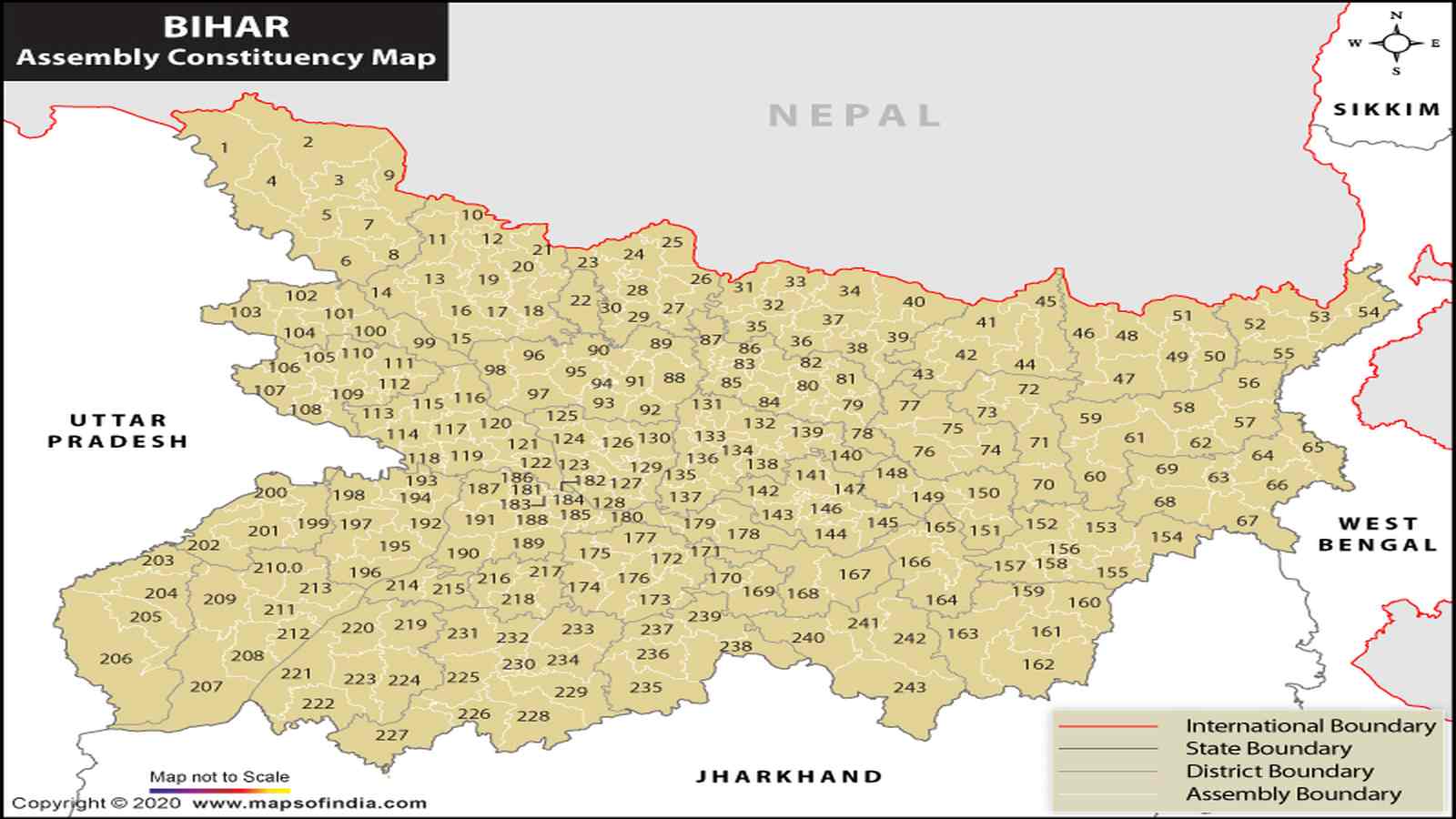
Hathua Assembly Constituency 2025: Hathua is an assembly constituency in Gopalganj district, in the northern Indian state of Bihar. It is a general category constituency (i.e. not reserved for SC/ST) and is part of the Gopalganj (SC) Lok Sabha seat.
Constituency-wise, Hathua comprises the Hathua and Phulwaria community development (CD) blocks, plus the gram panchayats Jamsar, Trilokpur, Mohaicha, Balesara, and Mirganj Nagar Panchayat of the Uchkagaon CD Block.
Voters and Local Issues
In 2020, the number of electors was about 2,91,681. Voter demographics include notable proportions of SC, ST, and Muslims. Specifically, in 2020 SC voters were ~12–13%, ST a smaller share (~3%), and Muslims around 17%.
Economically, Hathua is largely agrarian: land holdings tend to be small to marginal, with paddy, wheat, maize, etc., being important crops. There is also seasonal migration from poorer households, and local infrastructure (roads, electricity, water supply) remains a significant concern. Local issues also include caste-based inequalities, access to healthcare and schools, and law & order in parts.
Hathua Assembly Constituency 2025: Recent Political History
Hathua is a relatively new constituency in its current form, created via the delimitation exercise in 2008. Before that, similar areas were represented under different constituency names.
From 2010 through 2015, Janata Dal (United) (JD(U)) held the seat, with Ramsewak Singh Kushwaha winning in both those elections. In 2020, the Rashtriya Janata Dal (RJD) broke that run, winning with Rajesh Kumar Singh defeating Ramsewak Singh.
Election Numbers (2010–2020)
Voter turnout in 2020 was modest (in the range of ~57–60%), though exact earlier turnout figures vary.
Vote shares: In 2020, RJD had ~49.84% of votes; the runner-up JD(U) had ~32.29%.
Winning margins: In 2020, RJD won by ~30,527 votes over JD(U) in Hathua.
Between 2010 and 2015, Ramsewak Singh of JD(U) had comfortable wins, but not always huge margins; but he was able to maintain incumbent advantage until RJD’s push in 2020.
Hathua Assembly Constituency 2025: Past Complete Winners List
2020: Rajesh Kumar Singh (RJD) defeated Ramsewak Singh (JD(U))
2015: Ramsewak Singh (JD(U)) won
2010: Ramsewak Singh (JD(U)) won
Hathua Assembly Elections 2025 Voting Date
The Hathua seat in the Bihar Assembly Election was voted on November 6, 2025.
Hathua Assembly Elections 2025 Result Date
The Election Commission of India (ECI) has set 14.11.2025 as the date of results for the Hathua constituency, along with the polling result of all Bihar Assembly seats.
Hathua Assembly Elections 2025 Candidates List
| Party | Candidate Name |
|---|---|
| AAP | Indrajit Gupt Jyotishkar |
| BSP | Shabanm Khatun |
| Bhartiya Rashtriya Dal | Surendra Ram |
| JD(U) | Ramsewak Singh |
| Jan Suraaj Party | Sanjay Kumar Suman |
| RJD | Rajesh Kumar Singh |
| Rashtriya Sab Janshakti Party | Kalindra Kumar Ray |
| Suheldev Bharatiya Samaj Party | Laxman Bhar |
| INDEPENDENT | Nauraj Sah, Surendra Gupta |
What to Watch During the 2025 Contest?
1. Alliance arithmetic & seat sharing: If the NDA / JD(U) can consolidate their base and form advantageous local alliances (e.g. with smaller parties or caste‐based vote blocks), that can cut into RJD’s gains.
2. Reputation of the candidate & local achievements: The question will be raised about the performance of the incumbent RJD MLA.
3. Caste & voter identity: Caste identities especially that of Yadavs, Koeris/Kushwaha, Rajputs, and Muslim minority votes are going to be a vital aspect to consider.
4. Turnout & voter mobilisation: Voter turnout is a significant factor most times. The efforts for mobilisation by the parties (especially among the marginal voters), voter awareness, convenience in voting will all have an effect.
5. The influence of national/state narratives: The factors that may affect voters are the performance of the state government, national policies (on agriculture, inflation, employment), local development announcements, or controversies.