

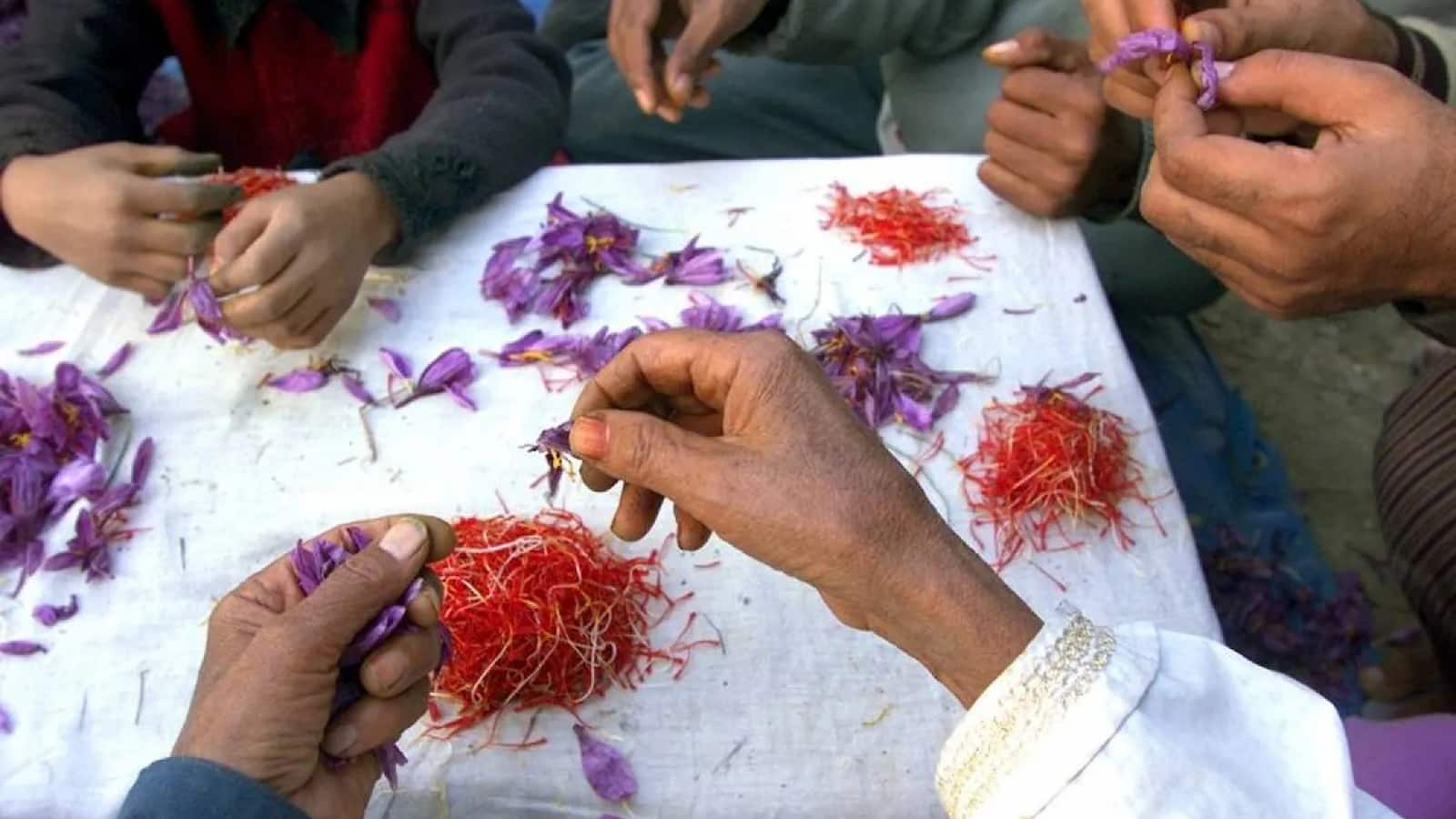
Kashmir Saffron Decline: Kashmir’s famous saffron crop is facing pressure from climate change, land conversion and weak farming infrastructure. At the same time, officials are now testing whether saffron can also grow in the cold and dry climate of Ladakh.
Agriculture Director Sartaj Ahmad Shah told ETV Bharat that Kashmiri saffron corms are among the best in the world and are popular in markets including Iran and Spain. Kashmir remains the main saffron-growing area in India. Pampore is known as the main saffron belt of the valley.
Jammu and Kashmir School Holidays 2026: Complete Month-Wise Calendar with Winter Vacations
800 Kg Iranian Corms Planted in Leh
Ladakh has started a pilot project using nearly 800 kg of premium Iranian saffron corms. Around 90,000 corms have been planted across nearly 4,000 square metres at Command Area Gate No. 27 in Spituk Pharka, Leh. The land had been barren but was recently restored under Project Him Sarovar.
Shah said Iranian corms were brought in because enough local corms weren’t immediately available in Kashmir. He also said Kashmir has stopped the sale or export of local saffron corms outside the valley to protect its planting material and increase cultivation under the Holistic Agriculture Development Programme.
“To protect internal resources, Kashmir’s agriculture department has banned the sale or export of Kashmiri saffron corms outside the valley. This is done to maximise local acreage under the Holistic Agriculture Development Programme (HADP),” said Shah.
The Iranian corms used in Leh are bigger and can flower earlier. “Saffron performance relies heavily on size, so corms weighing approximately 8 grams were selected for the Leh initiative. The use of corms between 8 and 10 grams helps accelerate flowering cycles,” Shah said.
Kashmir’s Saffron Sector Under Pressure
Saffron is one of the world’s most expensive spices and is traditionally linked with Kashmir’s Karewa lands. Officials and growers have raised concerns over climate change, dry weather and the loss of farmland. Recent government data says the total saffron area in J&K is 1,116.27 hectares. Production was 19.58 MT in 2024-25 after reaching 23.53 MT in 2023-24.
“Insufficient attention is being paid to saffron, which is not just vital but an expensive spice as well,” Shah said. He also blamed land conversion in Pampore, saying local fields are being bought for residential and commercial use.
New Nursery Planned to Protect Saffron
The condition of irrigation facilities is another issue. Shah said 84 of 124 planned borewells were built and handed over to growers with drip irrigation. He said farmers were expected to maintain them through Water Users’ Associations.
“Under the mission’s guidelines, local ‘Water Users’ Associations’ were required to handle the daily maintenance of the borewells, pipes, and infrastructure. Because the growers failed to form these associations, the irrigation systems fell into disrepair,” he alleged.
2027 ODI World Cup: Full Schedule, Format, India Matches And Final Details
“The department cannot be held responsible for routine upkeep, as it was a community obligation that went unfulfilled,” he added.
Shah also called for better saffron varieties and a government nursery. “Traditional seed stocks are currently used, but agricultural university scientists must focus on new varieties prepared through scientific means. The intervention will allow local growers to maximise their seasonal harvests while utilising minimal land plots,” he told ETV Bharat.
He said the planned nursery will help preserve and produce quality corms. “Interested farmers should take advantage of various active departmental schemes designed to maximise saffron cultivation and financially incentivise the growth of this highly valuable crop,” he added.