
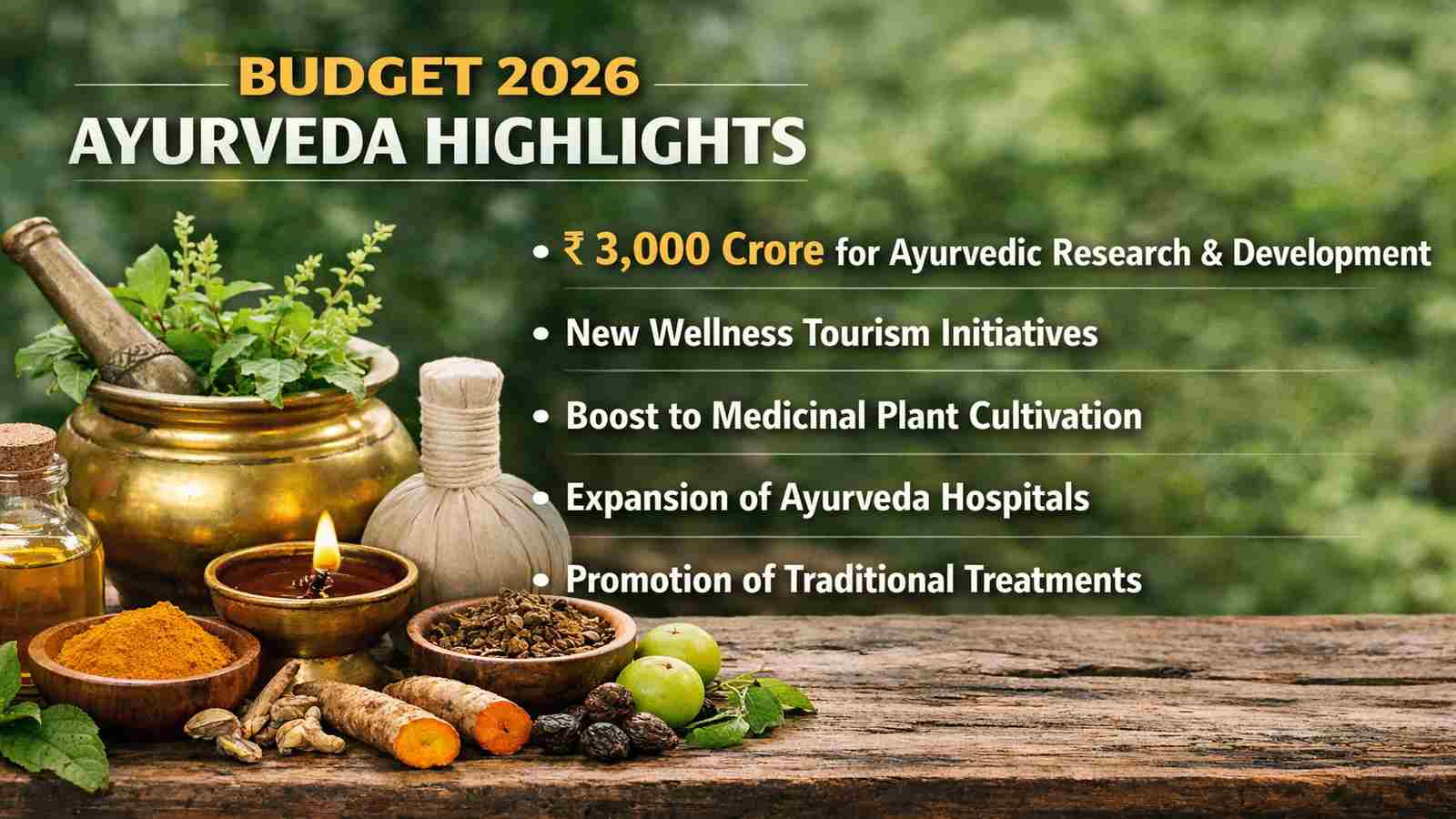
Budget 2026 Ayurveda Highlights: The Union Budget 2026-27 which Finance Minister Nirmala Sitharaman submitted to Parliament on 1 February 2026 showed a healthcare budget demonstration of Ayurveda and AYUSH (Ayurveda Yoga Naturopathy Unani Siddha Homoeopathy) as essential components of contemporary healthcare systems which support wellness and job creation and international relations.
Budget 2026 Ayurveda Highlights
The budget of this year frames Ayurveda as a growth engine which serves as an exportable product to international markets. The government established a future-oriented approach which positioned traditional Indian medicine as a fundamental component for developing health facilities and educational institutions and research facilities and job markets and tourist attractions.
View this post on Instagram
AYUSH received a budget boost which resulted in a major funding increase. The government raised its budget allocation for the AYUSH ministry by approximately 20 percent in Budget 2026-27 compared to the previous fiscal year.
Three New All India Institutes of Ayurveda
Perhaps the most headline-grabbing announcement was the proposal to establish three new All India Institutes of Ayurveda (AIIA) across the country.
View this post on Instagram
These national-level institutes are modelled on the success of the existing AIIA in New Delhi and aim to:
- Expand Ayurveda education and research
- Provide tertiary clinical care
- Support standardisation and quality control of traditional treatment.
Budget 2026 Ayurveda Highlights: Five Medical Hubs
Budget 2026 also proposed five new regional AYUSH medical hubs, strategic complexes that blend traditional medicine with modern diagnostic and rehabilitation facilities.
These hubs are meant to function as integrated centres of healing and employment, bringing Ayurveda and allied practices under one roof along with:
- Advanced diagnostics
- Post-treatment rehabilitation
- Skilled personnel like therapists and allied health professionals.
Upgrading AYUSH Pharmacies & Labs
Recognising that global confidence in Ayurvedic products depends on quality and safety, the government announced upgrades to AYUSH pharmacies and drug-testing laboratories. This is aimed at:
- Higher quality certification standards
- Stronger product testing infrastructure
- Wider availability of skilled professionals in the supply chain.
India’s Role in Global Traditional Medicine
Budget 2026 doesn’t focus only on domestic systems, it also looks outward. The WHO Global Traditional Medicine Centre (GTMC) in Jamnagar, Gujarat, is set for an upgrade with added support from the Government of India, positioning it as a knowledge hub for evidence-based research and international policy development.
Skill Development & Healthcare Employment
The government spent money to develop human resources for complete healthcare services which became the main accomplishment of the project.
The training program intends to train 150000 caregivers who will learn yoga practices.
The introduction of 10 new allied health disciplines includes applied psychology and anesthetics as well as optometry.
The program intends to train 100000 allied health professionals throughout the next five years.
Ayurveda & Integrated Healthcare Tourism
The AYUSH system used healthcare and wellness tourism as part of its overall narrative. The Budget’s vision establishes regional medical hubs which provide integrated services to attract both domestic and international medical tourists who seek traditional healing methods that modern facilities support.