
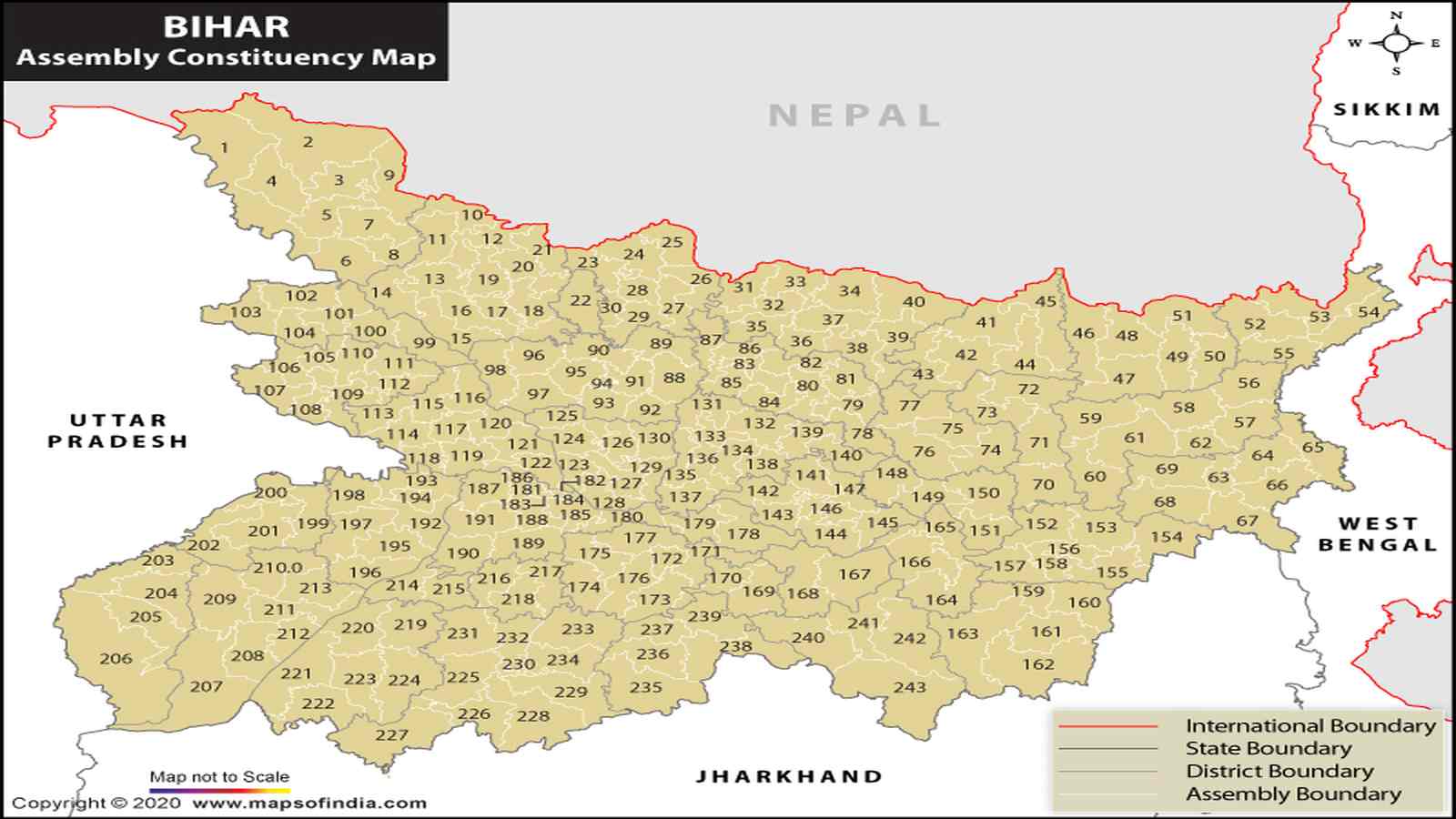
Digha Assembly Constituency 2025: Digha is an assembly constituency in Patna district, Bihar. It is part of the Patna Sahib Lok Sabha constituency. It was created after delimitation in 2008.
In terms of its boundaries, Digha consists of six gram panchayats and 14 wards of the Patna Municipal Corporation. These include wards such as 1, 2, 3, 6, and others (Patliputra Housing Colony, Badalpura, Sabazpura, Khalilpura etc.).
Voters and Local Issues
It is one of the largest such constituencies in Bihar by electorate size: in 2020 there were about 460,868 registered voters. The number increased to ~473,108 in the 2024 Lok Sabha poll in the same area.
Local issues tend to revolve around urban infrastructure (roads, drainage, public transport), sanitation, flooding/neighborhood drainage during monsoons (being near the Ganga), slum/locality-upgradation in mixed residential/poor urbanized panchayats, voter roll accuracy, and services (water supply, electricity). Also caste/community dynamics (Kayastha caste among others) play a role.
Digha Assembly Constituency 2025: Recent Political History
Since its creation in 2008 (post-delimitation), Digha has become a seat with relatively high voter numbers, and has seen political competition between BJP and Janata Dal (United), among others.
The sitting MLA (as of 2020) is Sanjiv Chaurasia from BJP, who won the seat in 2015 and retained it in 2020. Before him, in 2010, Punam Devi of JD(U) had won.
Over recent elections, vote share margins have varied, but BJP under Sanjiv Chaurasia got ~57% in 2020 in Digha, defeating notable rivals (e.g. from CPI(ML)(L)).
Bikram Assembly Constituency 2025: Full Candidate List, Poll Date, Past Results and Winning Margins
Election Numbers (2010–2020)
In 2010, voter turnout in Digha and the total number of voters were lower compared to later years, but already substantial. Punam Devi (JD(U)) secured 81,247 votes in 2010, defeating her nearest rival from LJP by a large margin.
In 2015, Sanjiv Chaurasia (BJP) won with ~92,671 votes. In 2020, his vote count rose to ~97,318 votes, with a vote share of ~57.09%. His main rival in 2020 was Shashi Yadav of CPI(ML)(L) who got ~29.97%.
Digha Assembly Constituency 2025: Past Complete Winners List
Since Digha only came into existence post the 2008 delimitation, full “pre-2008” winners for exactly the same boundary don’t strictly apply; but here are the past winners since 2010:
2010: Punam Devi (JD(U))
2015: Sanjiv Chaurasia (BJP)
2020: Sanjiv Chaurasia (BJP)
Digha Assembly Elections 2025 Voting Date
The Digha seat in the Bihar Assembly Election was voted on November 6, 2025.
Digha Assembly Elections 2025 Result Date
The Election Commission of India (ECI) has set November 14, 2025, as the date of results for the Digha constituency, along with the polling results of all Bihar Assembly seats.
Digha Assembly Elections 2025 Candidates List
| Party | Candidate Name |
|---|---|
| BJP | Sanjiv Chaurasia |
| BSP | Prabhakar Kumar Singh |
| Bharatiya Momin Front | Indu Devi |
| CPI(ML)(L) | Divya Gautam |
| Jagrook Janta Party | Sadhana Kumari |
| Jan Suraaj Party | Ritesh Ranjan Singh |
| Right to Recall Party | Rajiv Kumar Singh |
| The Plurals Party | Pranjal Singh |
| Vocal India Party | Richa Sinha |
| INDEPENDENT | Kusumlata Verma, Shwet Ranjan |
What to Watch During the 2025 Contest?
1. Incumbent Performance and Anti-Incumbency: Sanjiv Chaurasia of BJP has been the elected representative of the Lok Sabha seat since 2015. The question whether local dissatisfaction (over infrastructure, public services etc.) will lead to anti-incumbency is quite a big one.
2. Opposition Unity / Alliance Configurations: It depends on how (Mahagathbandhan or other alliances) the opposition put forward a single strong candidate as opposed to multiple parties (Left, JD(U), RJD, Congress, etc.) splitting the votes.
3. Voter Turnout and Electoral Roll Accuracy: In view of past incidents of errors in the voter list, low turnout in certain urban wards, and special enrolment drives.
4. Demographic and Caste/Community Dynamics: The voting patterns linked to caste (e.g. upper castes, Kayasthas, other influential communities), economic class (urban middle class vs poorer localities), and also migration/settlement changes could have altered the traditional loyalties.
5. Effect of State-Level Issues & Alliances: Firstly, the issues that are causing inflations, unemployment, law, and order, promises by state parties (relating to schemes, subsidies etc.)