

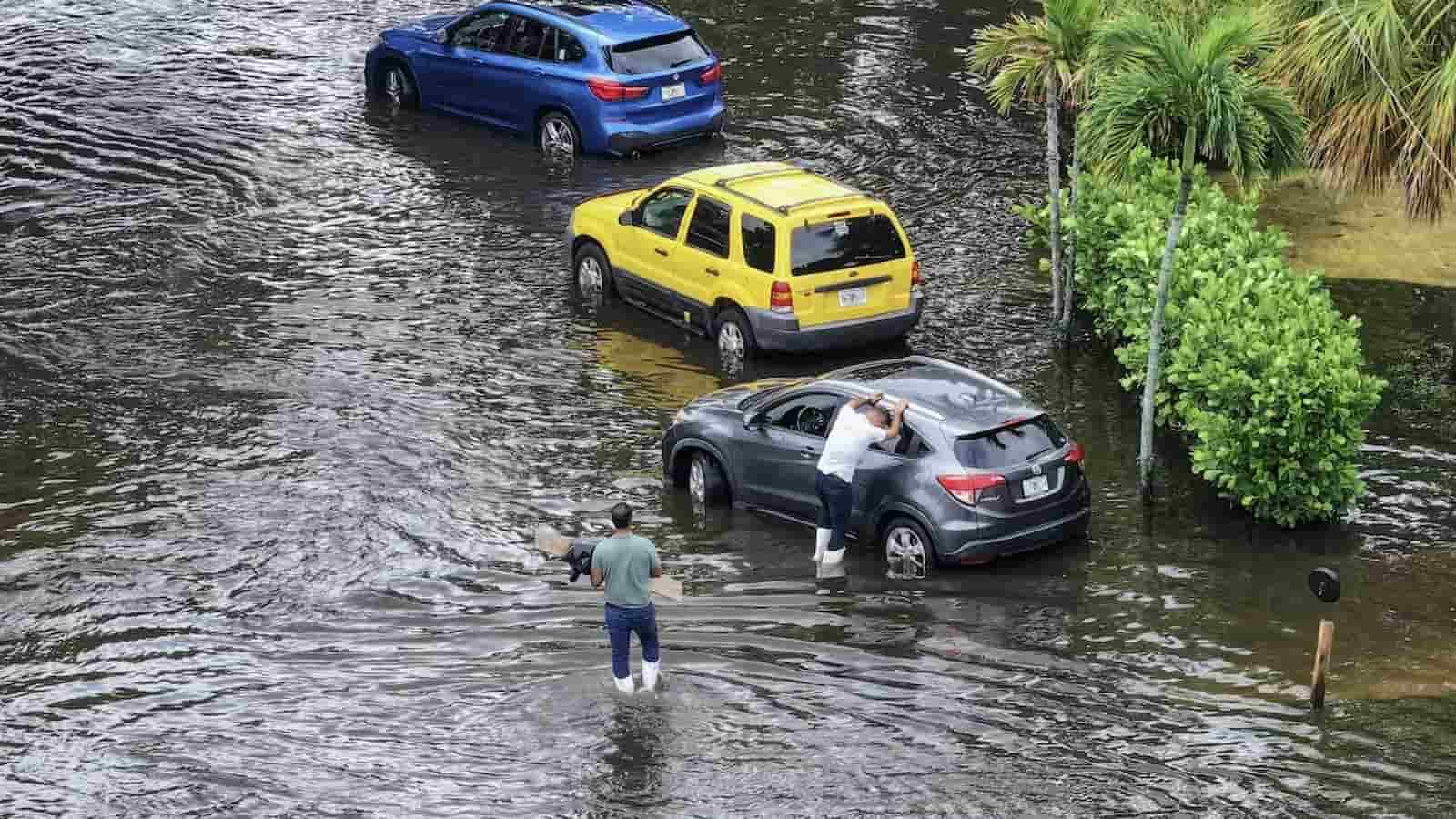
Flood Damage Car Insurance: Heavy rain in Delhi has once again brought a familiar problem for car owners into the picture. Trees can fall. Vehicles can get hit. Roads can flood. And then the same question comes up again and again: will insurance pay for the damage? The answer is not the same for every driver. It depends on the type of policy and also on how the damage happened. In India, a comprehensive motor policy usually covers damage from floods, storms and other natural calamities, while a basic third-party policy does not protect your own car.
As Kiran A Kumar, Head–Motor Underwriting at Tata AIG General Insurance, said, “Flood damage is generally covered under a comprehensive motor insurance policy. Since floods, heavy rain, cyclones and similar natural events are categorised as natural calamities, damage to the insured vehicle arising from such events may be covered, subject to the policy terms, conditions and exclusions,” said Kiran A Kumar, Head–Motor Underwriting at Tata AIG General Insurance. A standalone own-damage policy can also cover damage to the insured vehicle, while a third-party policy only covers harm caused to others.
Important Points About Loan Against Shares Interest Rate to Know
What is Covered and what is Not?
Insurance experts say a comprehensive or own-damage policy usually pays for flood-related damage to the body, suspension, upholstery and electrical parts of the car.
Niharika Saigal, Head of Insurance and In-App Categories at PhonePe, said, “A Comprehensive or Standalone Own Damage (OD) policy covers damage to the car’s body, suspension, upholstery and electrical components caused by floods, heavy waterlogging or cyclones. A basic third-party policy only covers damage caused to others and does not protect your own vehicle,” said Niharika Saigal, Head of Insurance and In-App Categories at PhonePe.
But not every rain problem is paid for. One of the biggest trapdoors is engine damage. If a car gets stuck in water and the driver tries to restart it, water can go into the engine and damage internal parts. That kind of damage is often treated as consequential loss and is usually not covered under a normal comprehensive policy.
Nitin Deo, Chief Technical Officer at Zuno General Insurance, said, “One of the most common examples of consequential loss is engine damage caused by attempting to restart a vehicle after it has stalled in a waterlogged area,” Deo said. IRDAI-linked policy wordings also show that consequential loss is commonly excluded in motor policies.
Home Loan Balance Transfer Explained: How Lower Rates Can Save You Lakhs
Kumar said this same problem is usually not covered unless the policy has an Engine Secure add-on. Shivendra Pancholi, Executive Director, Affinity Business at Coverfox, also pointed out that continued driving after the first damage and losses caused by negligence or intentional acts can lead to rejection too.
Saigal gave a very clear warning “If your vehicle gets submerged in water, do not crank or start it. Starting the vehicle while it is submerged can lead to hydrostatic lock, which is generally not covered under a standard policy. Coverage for such damage can be obtained through an Engine Protection add-on,” she said.
Claims and Delays
Experts say rain claims usually fail not because it rained, but because policy rules were not followed. Deo said, “A claim may be rejected if the damage falls outside the scope of the policy or if policy conditions are not followed,” Deo said. He added that delays in telling the insurer, poor documents, or getting repairs done before inspection can create trouble.
Kumar also said insurers may reject a claim if a driver knowingly drives through a badly flooded road or continues driving after the car stalls in deep water. Pancholi added that insurers may also reject a claim if the policy has expired, the damage is excluded under the policy, or the policyholder provides false information. Motor policy wordings also expect the insured person to take reasonable steps to protect the vehicle and avoid extra damage after an accident or breakdown.
How to Improve Personal Loan Eligibility Before Applying
Saigal’s advice is simple and practical:
- Do not restart a car that has gone under water.
- Tell the insurer quickly.
- Take photos or videos.
- Move the vehicle to an authorised workshop with a tow truck.