
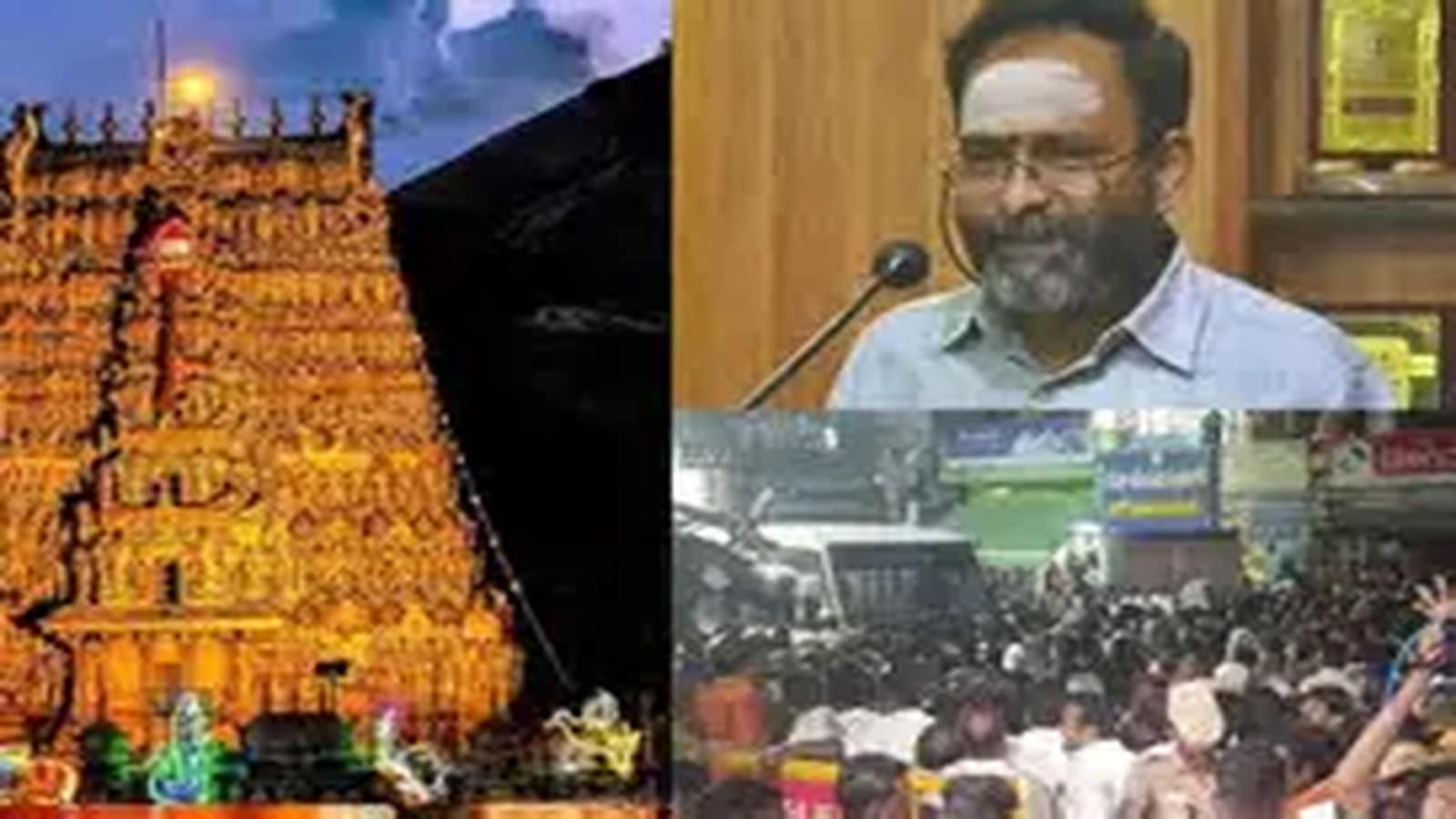
Thiruparankundram Deepam Controversy: A fresh controversy has been further stirred following the refusal to light the Karthigai Deepam at the Deepathoon despite a Supreme Court order allowing this to occur on an exceptional basis. In addition, the Tamil Nadu government has since apologised to the court and the BJP has alleged that the state government has not respected the court’s decision.
Whilst the Deepathoon, a stone pillar is around 50 metres away from the Sulthan Sikkandar Badusha Auliya Dargah, Hindu bodies and devotees are lobbying for the Karthigai Deepam to also be lit at this site as they state that it is a traditional Deepathoon.
The temple authorities and Tamil Nadu government, however, have insisted that the Deepa Mandapam close to the Uchi Pillaiyar temple is where the Deepam is traditionally lit.
Following this, the Supreme Court allowed, on an exceptional basis, the Deepam to be lit at the Deepathoon on November 24, imposing certain conditions.
What Is the Thiruparankundram Deepam Controversy?
As previously mentioned, the Thiruparankundram Deepam controversy is about where the Deepam should be lit during the annual Karthigai Deepam festival.
Thiruparankundram hill is in Madurai and is a key religious site. It contains the Arulmigu Subramaniya Swamy Temple, one of the 6 Arupadai Veedu (sacred abodes) of Lord Murugan.
It also contains the Sulthan Sikkandar Badusha Auliya Dargah and so is important to both Hindus and Muslims.
Historically, the Deepam has been lit at the Deepa Mandapam close to the Uchi Pillaiyar temple on the temple premises. Yet, Hindu bodies and petitioners are pushing for the Deepam to also be lit at a further stone pillar on the hill. This is known as the Deepathoon.
Why Is Thiruparankundram Hill Important?
Thiruparankundram is not an average hill in Tamil Nadu. It is of great religious and historical significance. The Arulmigu Subramaniya Swamy Temple is dedicated to Lord Murugan and is traditionally seen as his first Arupadai Veedu.
According to Hindu beliefs, it was here that Lord Murugan married Goddess Deivanai following his triumph over the demon Surapadman. In addition, there are also indications of other historical influences upon the hill. These include ancient Jain rock formations and caves.
On the summit of the hill is Sultan Sikandar Badhusha’s tomb which led to the establishment of the dargah there. Given these various religious and historical influences, the hill has often been highly sensitive when issues such as religious practice, access and site utilisation have been at stake.
What Is Deepathoon And Why Do Devotees Want The Deepam Lit Here?
Deepathoon is essentially a Deepam pillar. It is situated on the upper part of Thiruparankundram hill and is some 50 metres from the dargah.
Hindu petitioners have stated that this pillar is a traditional Deepathoon and that the Deepam should be lit here. They believe that this will both recognise and adhere to prevailing religious practice and satisfy their long-held wish for this to occur.
The Madras High Court’s Division Bench, however, agreed with the petitioners’ view. It noted that the pillar contained a hollow which could be used to store oil and wicks, therefore confirming that it was indeed a Deepathoon. Compounding the situation, the Deepathoon is also relatively close to the dargah.
How Old Is The Dispute Over The Temple And Dargah At Thiruparankundram?
This dispute is in fact over 100 years old. The legal history of Thiruparankundram dates back to 1920 when the Arulmigu Subramanian Swamy Temple Devasthanam brought a suit, asserting its title to the whole hill.
A trial court judgement was given in 1923. It recognised the majority of the hill (excluding buildings) together with the pilgrimage route as temple property. However, it also recognised the hill’s summit together with the surrounding area of the mosque, Nellithope and steps to the mosque as Muslim property.
This judgement has since been referred to in other disputes. Further religious and access related disputes have also arisen at Thiruparankundram. There was controversy in 2021 about the replacement of a wooden pole in front of the dargah with an iron one.
Then, in early 2025, there was another dispute concerning an attempt to carry out animal sacrifice on the hill summit. This was later banned by the Supreme Court as the hill is a protected monument and therefore must abide by the Archaeological Survey of India’s guidelines.
What Occurred In The 1994-1996 Deepam Case?
Disagreement over lighting the Deepam on the hill summit is not a new issue.
In 1994, a petition was presented requesting that Hindu Munnani volunteers be allowed to light a Deepam on the hill summit. A Madras High Court judgement was then issued in 1996.
The court ruled that the Karthigai Deepam should be lit at another spot on the lower part of the hill, again close to the Uchi Pillaiyar temple.
It also permitted the temple authorities to explore alternative suitable sites for lighting the Deepam, again imposing conditions. These included the requirement for the chosen site to be no less than 15 metres away from the dargah, steps and Nellithope.
As a result, the Deepa Mandapam near the Uchi Pillaiyar temple remained the traditional site for the annual Deepam.
Guruvayur Temple To Start Special Darshan Queue For Mothers With Children From December 1
How Did The Controversy Resurface In 2025?
In November 2025, a group of devotees petitioned the Madras High Court for permission to light the Karthigai Deepam at the Deepathoon.
On December 1, 2025, a single judge held that the temple authorities should light the Deepam at the Deepathoon. This was regarded as an attempt to revive religious practice.
Furthermore, the court ordered that police should support the lighting of the Deepam.
However, when the temple authorities said they were unable to comply with this order, citing law and order concerns, contempt proceedings were instituted. The case was then heard by a Division Bench of the Madras High Court.
On January 6, 2026, this bench agreed with the earlier ruling. It, however, altered the process so that only a limited number of people would be allowed to light the Deepam. It also ordered the district administration to oversee the lighting of the Deepam and ensured that the Archaeological Survey of India’s guidelines would be adhered to.
What Did The Supreme Court Rule On November 20, 2026?
On November 20, 2026, the Supreme Court re-ignited interest in this case by issuing an interim order. It permitted the Karthigai Deepam to be lit at the Deepathoon on November 24. Nevertheless, it emphasised that this was on an exceptional basis and should not be seen as an endorsement of any permanent religious or property rights in relation to the Deepathoon.
Why Was The Deepam Not Lit At Deepathoon On November 24?
This became the main question after the Karthigai Deepam festivities on November 24.
Whilst the Supreme Court had allowed the Deepam to be lit at the Deepathoon, in fact it was lit at the traditional Deepa Mandapam near the Uchi Pillaiyar temple.
This led to criticism from both devotees and political bodies, with claims that the authorities had not complied with the court’s order.
The Tamil Nadu government then provided further clarification of its position to the Supreme Court. According to the status report by Madurai District Collector Nishant Krishna, dated November 25, the district administration had organised for the Deepam to be lit.
Between November 20 and 22 meetings were held to plan how this should be achieved. Issues discussed included the personnel involved, the date and the method of access and security provision.
Whilst consideration was given to a 10-strong team comprising temple personnel, priests and technical staff from Thiruvannamalai, the temple’s Board of Trustees did not approve this team.
Instead, in a November 24 resolution, the trustees opted to light the Deepam at the traditional site.
What Comes Next For The Thiruparankundram Deepam Case?
The November 20 Supreme Court order was confined to an exceptional exception for the 2026 Karthigai Deepam festivities. It did not therefore provide permanent approval for the Deepam to be lit at the Deepathoon. Nor did it resolve the differing interests in relation to Thiruparankundram hill.
The Tamil Nadu government has also lodged a review petition against the interim order.
Future legal action will be crucial in shaping the progression of this case. This will involve examining the historical nature of the Deepathoon, relevant religious traditions and the respective interests of those involved.
For now though, the Thiruparankundram Deepam continues to provide an important opportunity to observe the interplay between religion, the judiciary and the administration at a site of multi-faith significance.