


8th Pay Commission Arrears Calculation: The setting into motion of a fresh Pay Commission in India has always become a decisive moment for a large number of central government beneficiaries, including employees and pensioners, not only because of the new pay scales and perks but also because of the arrears.
The 8th Pay Commission is going to change the salaries and pensions from January 1, 2026, so the issue of arrears and the formula for its calculation has gained great interest and is of great financial importance as well.
What Are Arrears Under the 8th Pay Commission?
Arrears refer to the amounts that the employers owe to their workers and to the retired employees for the period between the official date of the new pay rules plus post-dating the actual payment of the revised salaries. With regard to the 8th Pay Commission the government has expressed that although the provisions shall be legally effective from January 1, 2026, the actual implementation could be postponed into 2027 or even later since it will take time for the completion of the report submission, cabinet approvals, and budget allocations.

It is the difference between the effective date and the real rollout that creates the arrears gap. The employees continue to get their old salaries while their new entitlement is piling up as arrears until it is officially put into. The reason why arrears arise is the difference in time between the effective and the implementation date.
8th Pay Commission Arrears Calculation
To understand the concept of arrears, you need to understand these two terms first:
- Effective Date: The date which marks the new pay structure of the 8th Pay Commission being legally applicable (in this case 1 January 2026).
- Implementation Date: The day on which the Government officially announces the new salary and starts paying the employees.
As the Commission has to first complete and approve its recommendations, which is usually a time-consuming process, arrears will accumulate for each month from January 2026 until the actual date of implementation.
The arrears payable are basically calculated by how much more an employee (or pensioner) is entitled to under the new pay structure as compared to what they were actually paid during the period of delay.
Important Components in the Arrears Formula
When calculating total arrears, the following elements are important:
1. Basic Pay & Fitment Factor
The change in the basic wage is the first main issue. Usually, the new basic wage is calculated by applying a fitment factor which is a multiple of the basic wage according to the 7th Pay Commission. Even though the official figure for fitment is not declared yet, different forecasts and experts’ computations place it between 2.5 to 3.0 times the present basic pay.
2. The allowances (HRA, TA, and others)
Allowances like HRA and TA will be computed on the amount of the new basic salary and might as well be part of the accumulated payments. Nevertheless, previous instances of Pay Commission transition suggest that the government will have particular rules regarding the payment of HRA and that the specific government rules will be announced at the time of implementation.
3. Dearness Allowance (DA)
With the Pay Commission revisions, DA is set and recalculated. Whenever the DA rate is changed for a previous period, DA arrears are incurred, but it is also possible that the interaction with the fitment factor will be such that DA arrears do not come up at all (that is, separate from basic pay) depending on how the Commission ultimately decides DA policy.
8th Pay Commission Explained: Arrears Start Date, Salary Hike Timeline, and Government Stand
Core Formula for Calculating Arrears
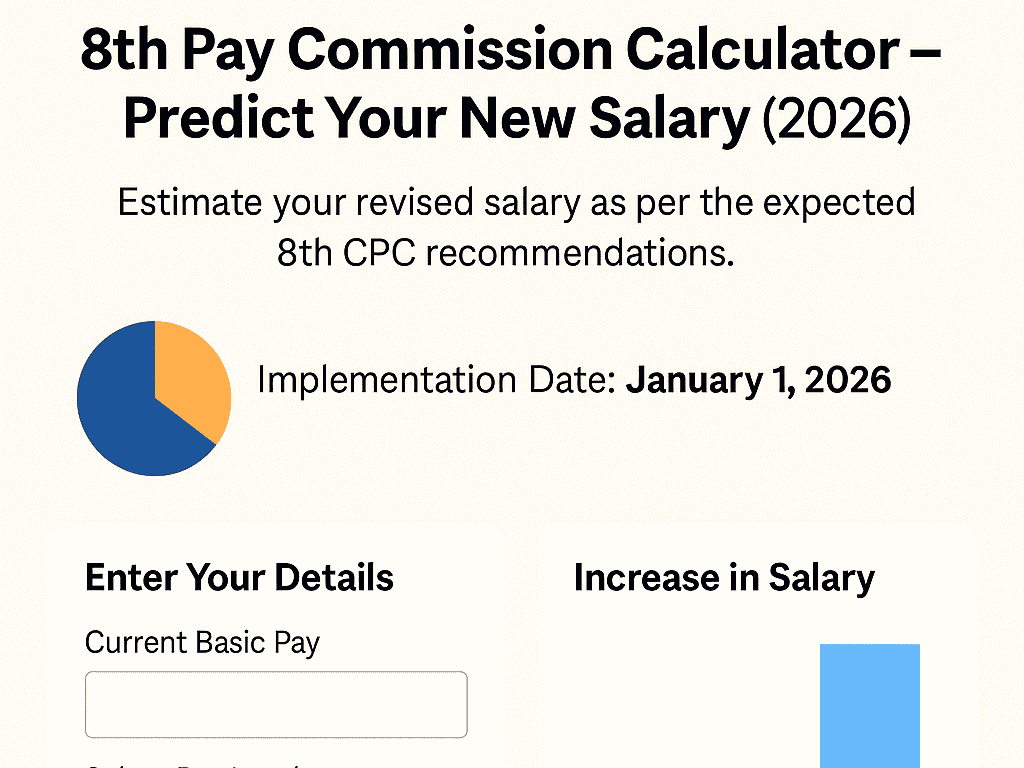
Let see with a realistic example, the way in which arrears could be calculated:
- Pay per month before the 7th CPC: ₹45,000
- Pay per month after the 8th CPC: ₹50,000
- Delay in implementation: 15 months
Step 1: Monthly Difference
Step 2: Arrears Over Delay Period
Thus, when the new pay structure is finally implemented, in addition to the monthly revised salary, ₹75,000 would have to be paid as arrears.
Other than that, there are few dedicated platforms for the 8th Pay Commission such as:
https://8thpaycommission.net/8th-pay-commission-salary-calculator/
However these platforms may not calculate the arrears as per recent developments.
Tax Implications and Financial Planning
The due amount should be reported as taxable income in the fiscal year that income was received. Consequently, the total arrear amount can raise the employee’s income to a higher tax slab, in many cases, up to 30%, depending on the total taxable income.
By using the right approach, such as filing a tax relief petition under Section 89 of the Income Tax Act, the tax liability on a large amount of arrears received in a lump sum can be decreased. Arrears under the 8th Pay Commission are the major source of money and have a material positive financial impact, in particular, if the implementation is delayed.
The core idea is quite simple: arrears are the difference between the new and old salaries multiplied by the number of months of delay counted from the legal effective date (1 January 2026) to the date of actual implementation.