
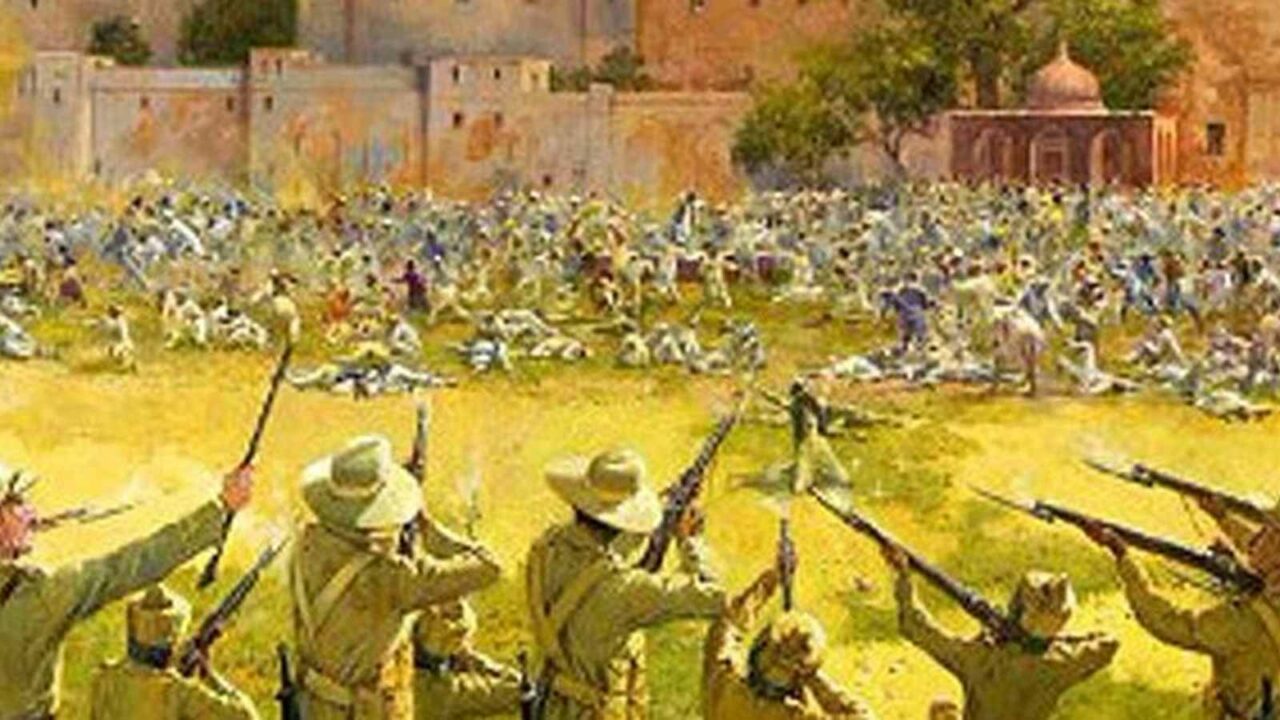
Jallianwala Bagh Massacre: General Dyer ordered his troops to fire on an unarmed crowd of men, women, and children stranded in an abandoned walled garden during a Sikh festival on April 13, 1919. The atrocity killed 379 and injured 1,500.
April 1919 Punjab and other disturbances led to the Jallianwala Bagh massacre. Dyer was despatched by the Governor of Bengal to retake Amritsar after the British lost control on 11 April. Dyer believed he had used force to stop the civic turmoil that had killed five Europeans. Dyer was fired following the massacre. The massacre may have been the most notorious event in British colonial India.
Jallianwala Bagh Massacre: Background
The British Raj (government) of India began in 1858 when the Crown and state took over the British East India Company’s assets. (EIC). The EIC ended with the 1857-8 Sepoy Mutiny. The violence committed by both sides in this insurrection against colonial control left a lasting effect, especially on the British, who feared another outbreak. Britain dominated a divided India. Political maps show how Indian princely states were dependent or neutral. Hindus, Muslims, and Sikhs divided faiths. Caste and economic differences existed also. Many Indians worked in the British Indian Army and civil service. The British Empire’s biggest problem was maintaining this shapeshifting cultural melting pot. British imperialism’s prized jewel was India, and exploiting its resources without uprising was tricky.
Many conservative Britishers became obsessed with the possibility of rebellions, and there were signs that Indians were warming up to political unification. The All Indian Muslim League was founded in 1906, and the India National Congress in 1885. Bengal’s 1905 division enraged nationalists. (it was reversed in 1911). After mass-based politics emerged in the first decade of the 20th century, more Indians challenged British rule. In 1916, the Congress and Muslim League signed the Lucknow Pact, which outlined constitutional reforms needed for Indian independence.
World War I exacerbated Indian colonial tensions. (1914-18). Indian soldiers who fought for British interests in India and overseas (Europe, the Middle East, and East Africa) struggled to find work. The British administration’s failures were highlighted by India’s wartime donations. British interests feared the Punjab region in northern India. The Ghadar party, which sought to overthrow the British, united Indians of many faiths.
March 1919 Rowlatt Acts followed. These legislation permitted the British government to use control and jail to crush protests during the World War. Indians were imprisoned, tried without a jury, and humiliated. The Rowlatt Acts prompted Indian independence leader Mahatma Gandhi (1869-1948) to call for a work stoppage on 8 April. Many Indians followed Gandhi’s peaceful civil disobedience, but the British refused to abolish the Acts. Riots, burning, looting, and police battles occurred in Amritsar, Punjab, where a mob killed five British men on April 10. Delhi and Ahmadabad had further riots. Gandhi was detained, but his supporters disobeyed his call for restraint. Unrest prevented any public gatherings.
Gen. Dyer
Brigadier-General Reginald Edward Harry Dyer (1864-1927), a professional soldier of Irish heritage from India, had served in Persia and returned to India. He was 55 in 1919 and nearing retirement. Dyer’s decision-making in Persia was questioned when he expanded British territory without orders. Dyer returned to India and took command of the 45th Brigade of the British Indian Army at Jalandhar after being saved from dismissal in Persia by illness.
Sir Michael O’Dwyer, Punjab Governor, was opposed to Indians having a say in their government and had ordered aircraft to shoot rioters. Dyer and O’Dwyer were paranoid that 1919’s turmoil would turn like the Sepoy Mutiny of 1857-8. There were also allegations and conspiracies that Soviet Russia was supporting Indian nationalists to overthrow the Raj. After two senior Indian nationalists were arrested on 10 April, O’Dwyer sent Dyer to Amritsar to quell the disturbances.
On 11 April, Dyer saw two banks and two mission schools looted and burned in Amritsar. A European doctor was beaten and several Europeans were killed. As the British lost control of Amritsar, a city of 150,000, the other Europeans had to flee to Gobindgath Fort.
Dyer, two armoured cars, and 90 men arrived at Jallianawala Bagh around 5 PM.
Dyer mobilised 400 soldiers and two machine-gun-equipped armoured cars on April 12. The men paraded through Amritsar without violence. Dyer ordered all public meetings, processions, and gatherings to be banned on 13 April. That day’s curfew was 8 pm. Dyer heard disturbances in other Indian cities and rumours that his Indian men would not shoot on Indians if commanded. The rumour of a large gathering that afternoon defying Dyer’s directives was more important. The brigadier-general may have decided to demonstrate Amritsar’s residents that the British were back in charge.
Peaceful Crowd
On the afternoon of 13 April, 15–20,000 Indian citizens congregated in the abandoned walled garden of Jallianwala Bagh, which had only five small gates. Many people calmly celebrated Sikh Baisakh and its fair. Others protested the recent detention of nationalists, and others were going by because it was a major city road and the location of the Golden Temple, a Sikh temple. The garden was a wasteland that could handle such a large crowd. As many were from outside Amritsar, Dyer’s morning announcements may have been unknown to them. Some of the throng went home after a British plane flew over.
Dyer arrived at Jallianwala Bagh at 5 pm with two armoured cars and 90 men, principally Gurkhas and Indian forces. Dyer ordered only his men into the plaza since the entryway was too narrow for the two armoured cars. Dyer instructed his men to start and keep firing at the throng without warning. No warning shots. Soldiers reloaded their mags during the ten-minute bloodbath. Shots totaled 1,650. Dyer ordered his men to attack escapees at the enclosure’s high walls and openings. Dyer’s soldiers left without helping the wounded. Official data report 379 deaths and nearly 1,500 injuries. Death toll may have been higher.
Dyer ordered the public whipping of Indian inmates and compelled any Indian guy in Kucha Kurrichhan street (where the European doctor had been beaten) crawl on the pavement. O’Dwyer ordered aircraft to target Gujranwala rioters after Punjab proclaimed martial law. Following months saw police brutality against civilians. 1,200 died, 3,600 were wounded, and 258 were publicly flogged.
50 years of Project Tiger: PM Modi to inaugurate 3-day mega event in Mysuru on April 9
Jallianwala Bagh Massacre: Reaction
From the lowest to the viceroy Lord Chelmsford, many Britishers believed that O’Dwyer and Dyer had prevented the Punjab insurrection from expanding and growing to an uncontrollable scenario. However, dissatisfaction rose, especially once the martial law press embargo ended in June. Dyer’s Afghan campaign also diverted attention from Amritsar. Finally, the reckoning.
Lord Hunter chaired a London government committee that held a public inquiry on the killing in November 1920. The Lahore committee had four British, three Indians, and Hunter. Dyer was cross-examined by Indian lawyers and did himself no favours when he stated he would have deployed his machine-gun-toting armoured cars if he could have gotten them closer to the throng. Dyer said it was the only way “to produce the necessary moral and widespread effect” that disobedience would not be permitted, unapologetic for his conduct. (Mansingh, 201). The committee concluded that Dyer’s bigotry towards Indians and probably mental instability influenced his judgements. The Hunter Committee condemned Dyer and O’Dwyer for excessive force, but the British members believed that action was required to maintain British dominance in India. British authorities were foolish to think the committee’s findings would resolve the issue. Anger grew. Chelmsford altered his mind and told King George V (r. 1910-1936) that Dyer may not be the heroic protector of the British Empire. Dyer returned to England after six months’ leave.
Amritsar might also boost the budding Indian Independence cause. Nationalists, many of whom were attorneys who had painstakingly gathered evidence of the killing, now had another horrific example of British colonial power to use to persuade Indians to adopt “home rule.” The nationalist movement had obviously moved from denouncing British institutional racism, snobbery, and money drain to criticising Britain’s presence in the subcontinent. After a year, the slaughter was a significant story and a turning point in Indian-British relations.
Dyer’s callousness and subsequent attitude outraged London’s British establishment. Legislators who understood that force cannot reign sought to grasp the general’s motivation. “I had to shoot. I had thirty seconds to decide what action to take and I did it. Every Englishman I have met in India approved the act, horrible as it was,” Dyer told an English journalist. (James, 478). Despite the House of Lords vote, the establishment was turning against him, at least publicly. Dyer was told to resign and retire. The British press, however, supported Dyer. Northumberland farmers and Rudyard Kipling donated to the Morning Post’s Dyer fund, which was very successful. Many thought Dyer had moved with exceptional decisiveness to safeguard the British Empire and that officials who didn’t understand colonial reality had unfairly punished him. According to legend, Dyer saved the empire. Dyer’s retirement fund raised £26,000 (nearly $1 million today). The British government gave each massacre victim family £37 ($1600).
Empire Fall
Massacre offended Indians. Bengali author Rabindranath Tagore (1861-1941) returned his knighthood in anger. The Raja of Nabha, a pro-British princely state ruler, disapproved of Dyer’s disproportionate use of force. Dyer’s incredible pension “reward” startled many Indians more than the massacre. It was no longer feasible to blame a disobedient soldier. “I realised then, more vividly than I had ever done before, how brutal and immoral imperialism was and how it had eaten into the souls of the British upper classes,” said future Indian prime minister Jawaharlal Nehru (1889-1964). (Tharoor, 173). The Hunter Committee’s failure to find anyone guilty after so much unnecessary murder and humiliation in the Punjab in 1919 showed that the British administration had erased history. Above all, Gandhi’s non-cooperation movement gained popularity and continued to advocate for “home rule” from 1920. Indians of all classes worked harder to convince Britain to grant independence in 1947. Historian S. “Jallianwala Bagh began the end of British rule in India,” says Mansingh. (201).