
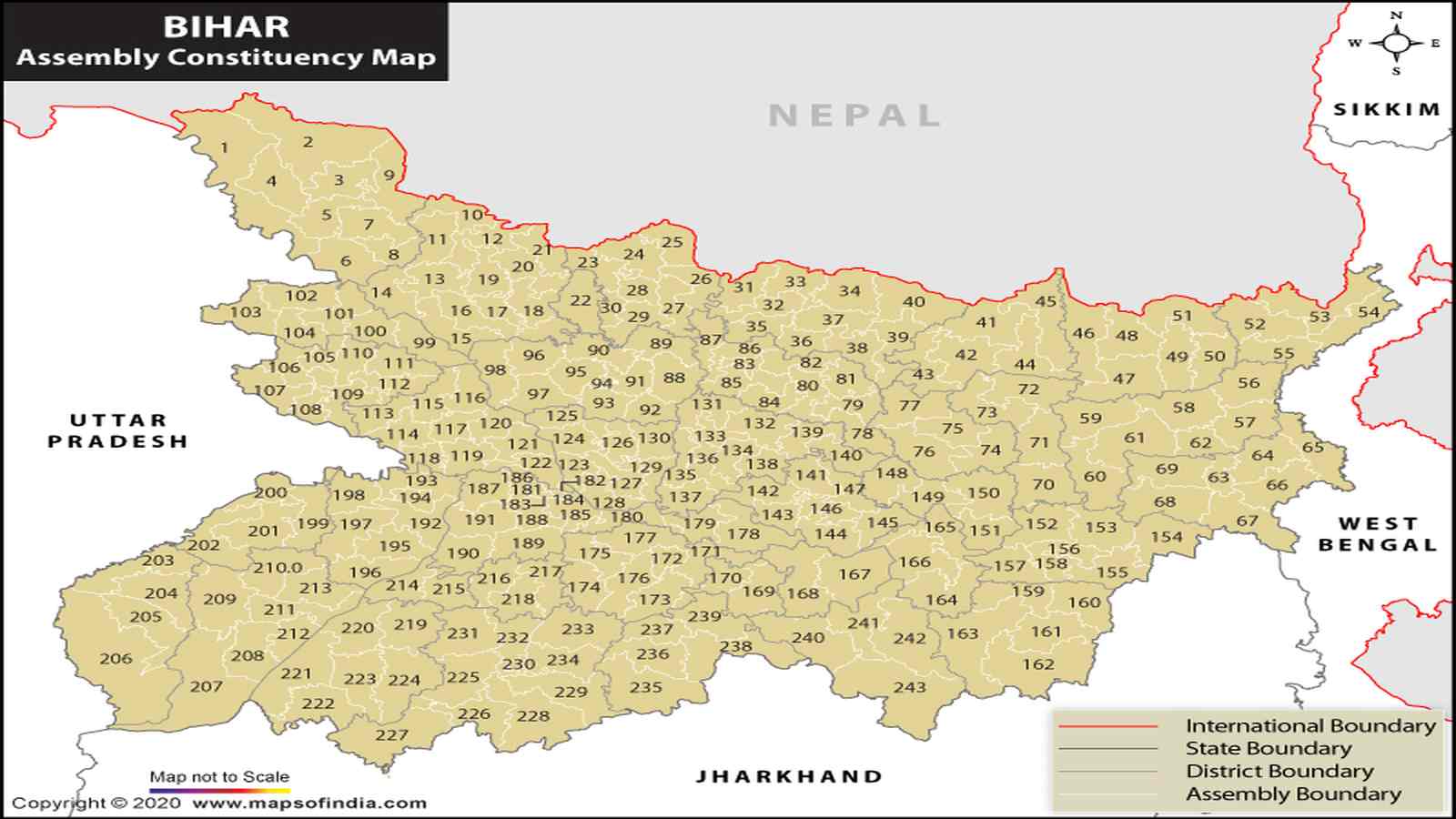
Banmankhi Assembly Constituency 2025: Banmankhi is an assembly constituency in Purnia district of Bihar. It is reserved for Scheduled Castes (SC).
As per delineation (2008), the constituency includes the Banmankhi community development block, plus 11 gram panchayats from the Barhara Kothi block.
Geography, Voters and Local Issues
Demographically, Banmankhi as a town/sub-division is noted for its sugar mill (now non-functional), its religious-tourist sites (for example, temples like Narsimha) and its proximity to Purnia (around 30-plus km).
Voter issues often revolve around:
Infrastructure: Condition of roads, connectivity, electricity, water supply.
Economic livelihoods: Agricultural inputs, market access, employment (esp. in public sector or allied sectors) given lack of industrial activity.
Social welfare schemes and services (health, education), especially access for SC communities.
Civic amenities in rural gram panchayats (sanitation, drinking water, health centres) and local governance.
Banmankhi Assembly Constituency 2025: Recent Political History
In recent Bihar elections, Krishna Kumar Rishi of the Bharatiya Janata Party (BJP) has been a prominent figure in Banmankhi. He won the seat in 2020, defeating Upendra Sharma of RJD by a margin of 27,743 votes.
Krishna Kumar Rishi also won in 2015, beating Sanjiv Kumar Paswan of RJD by a slim margin of about 708 votes.
BJP has historically been strong in this constituency, going back a number of elections. Local SC candidates with strong community ties and personal vote-bases have typically been put forward. Moreover, besides RJD, there are other regional parties.
There is current media chatter about whether Krishna Kumar Rishi can win for a sixth time in this seat which suggests he has won multiple terms.
Election Numbers (2010–2020)
2010: Krishna Kumar Rishi (BJP) won with about 67,950 votes; the total valid votes were ~126,520, giving him a strong margin over RJD and others.
2015: Vote share became more competitive. Krishna Kumar Rishi won with ~59,053 votes; runner-up Sanjiv Kumar Paswan (RJD) got ~58,345, a margin of just ~700 votes. This shows a tightened contest. Total valid votes were ~164,850.
2020: BJP’s Krishna Kumar Rishi again increased his winning margin. He got ~93,594 votes; RJD’s candidate ~65,851; margin ~27,743 votes. Total valid votes ~180,879.
Banmankhi Assembly Constituency 2025: Past Complete Winners List
1962: Bhola Paswan Shastri
1967: Baldeo Saraf
1969: Rasiklal Rishideo
1972: Rasik Lal Rishideo (INC)
1977: Balbodh Paswan (Janata Party)
1980: Jaikant Paswan (INC(U))
1985: Rasik Lal Rishideo (INC)
1990: Chunni Lal Raj Banshi (BJP)
1995: Chunni Lal Raj Banshi (Janata Dal)
2000: Deo Narayan Rajak (BJP)
Feb 2005: Krishna (BJP)
Oct 2005: Krishna (BJP)
2010: Krishna Kumar Rishi (BJP)
2015: Krishna Kumar Rishi (BJP)
2020: Krishna Kumar Rishi (BJP)
Banmankhi Assembly Elections 2025 Voting Date
Banmankhi is voting today (11.11.2025) as part of Bihar’s second phase of polling.
Banmankhi Assembly Elections 2025 Result Date
The Election Commission of India (ECI) has set 14.11.2025 as the date of results for the Banmankhi constituency, along with the polling result of all Bihar Assembly seats.
Banmankhi Assembly Elections 2025 Candidates List
| Party | Candidate Name |
|---|---|
| BJP | Krishna Kumar Rishi |
| BSP | Subodh Paswan |
| INC | Deo Narayan Rajak |
| Jan Suraaj Party | Manoj Kumar Rishi |
| Suheldev Bharatiya Samaj Party | Asha Devi |
What to Watch During the 2025 Contest?
1. Incumbency and Candidate Reputation: Among others, Krishna Kumar Rishi has been MLA six times and his success record will be exposed. How a voter may judge the implementation of development works, the face-off of the promises.
2. Margin of Victory Trends: The difference between the two races in 2015 and 2020 was very interesting, and it would be worth seeing whether Rishi is capable of keeping his lead or the opposition parties are able to narrow the gap once again.
3. Role of SC Reservation and Caste Dynamics: Beforehand, Banmankhi is an SC reserved seat, so the candidate’s support among SC communities and caste identity will be decisive. What sub-castes are targeted for mobilisation, which party is most successful at social outreach, and so on are points to be looked at.
4. Party Alliances / Political Climate: The result in Banmankhi is going to be influenced by the way the big alliances (NDA, INDIA, or other alliances) are performing, their choice of candidates, strength of the campaign.
5. Voter Turnout & New / Youth Voters: Youth enrollment and interest have increased, thus, a high turnout can make the results change, especially in close races. Besides, it will be crucial how the electorate will decide between embracing the campaign promises or relying on the actual performance.