


Ayurvedic Diet For Newborns: Ayurveda has given utmost importance to nutrition and eating habits and Ahara is taken into consideration as one among the three pillars sustaining life (Traya Upasthambha). Quality of food consumed is a significant component which is held accountable for proper development and growth, especially in the case of infants whose development is extremely fast. Ideal nourishment of the child with proper nutrients is considered the best way to achieve proper growth and development that takes place at a high rate in the early years of life.
In modern times, there are millions of varieties available in market for childs. Newborn needs proper diet with less preservatives, sweeteners, taste or smell enhancers, and chemicals. Contrary to this, companies sell products to the market advertising them as herbal, ayurvedic or apt for babies’ consumption. Ayurveda solves this less administered problem with it’s rich texts by Acharyas and post natal care guide. This ancient understanding is being reintroduced as Nutraceuticals.
What are Nutraceuticals?
Nutraceuticals are natural, bioactive materials that provide demonstrated physiological benefits or reduce the risk of chronic diseases, above and beyond their basic nutritional function. They are considered “medical foods” that complement dietary plans and may be used alongside.
Navajata Shishu Paricharya (Ayurvedic Newborn care)

Navajata Shishu Paricharya (care of a newborn baby) in Ayurveda includes diet (Ahara) appropriate to the age and development of the child.
First 6 Months: Ayurvedic Diet For Newborns
Ashtanga Hridaya – Uttarasthana 1/11
“मातुः स्तन्यं हितं बालं स्तन्यं च हितकारकं।
बुद्धिवृद्धिकरं स्निग्धं दोषदुष्टिहरं परम्॥”
Mother’s breast milk is most beneficial to the baby. It nourishes the mind and body, enhances intellect, is unctuous (snigdha), and balances the doshas. The first milk (colostrum) is considered highly beneficial and sacred equated to nectar (Piyusha).
Sutika Charya: The Ultimate Guide for Ayurvedic Postpartum Care
Ayurvedic Tips for Lactating Mothers
Ahara (Dietary Guidelines)
• Regular use of snigdha (unctuous), madhura (sweet), and rasa dhatu rich foods increase breast milk.
• Avoid ruksha (dry), katu (pungent), tikta (bitter), and kashaya (astringent) tastes.
Aushadhi (Herbal Remedies)
Shatavari (Asparagus racemosus) is considered best for lactating mothers.
Charaka Samhita (Chikitsa Sthana 30/142):
शतावरी क्षीरेण सिद्धा स्तन्यवर्धनमुत्तमम्।
Translation: Milk processed with Shatavari is the best for promoting breast milk.
Bhaishajya Ratnavali (Stanyajanana Adhikara):
स्तन्यं वर्धयते नित्यं शतावरीघृतं परम्।
Translation: Shatavari ghee taken regularly enhances breast milk significantly.
Other herbs like Vidari, Yashtimadhu, Shatapushpa, and Methi are great rasayana for increasing stanya (breast milk)
Acharya Charaka emphasizes Manasika Bhava:
माता प्रसन्नचेतस्या स्तन्यं अपि हितं भवेत्।
When the mother is mentally happy and calm, the breast milk becomes beneficial for the baby.
Medhya Rasayanas like Brahmi, Mandukaparni help reduce anxiety and support neuro-hormonal balance post-delivery.
After 6 Months: Ayurvedic Diet For Newborns
Kashyapa Samhita – Khila Sthana 12/3
“षष्ठे मासे स्तन्यदोषात् क्षीणपोषणहेतवः।
अन्नं लालयितं देयं बालेभ्यः क्षीरजैर्ननु॥”
From the sixth month, due to insufficiency of breast milk or increasing needs, soft food prepared with milk should be given to the infant.
After six months of age, breast milk alone is not enough to meet the requirements of growing child. The gap between nutritional requirement and amount obtained from breast milk increases with age. So complementary feeding has to be initiated during this period to meet up with the extra energy requirements.
Ayurvedic Management of Constipation: Why shouldn’t you pop antacids frequently?
Concept of Complementary Feeding: Ayurvedic Diet For Newborns

Complementary feeding refers to food which complements breast milk and ensures that the child continues to have enough energy, protein and other nutrients to grow normally Ayurveda has also greatly emphasized complementary feeding practices and its initiation is considered as an important milestone in the life of the child. Breast feeding should be continued along with complimentary feeding up to 2 years of age.
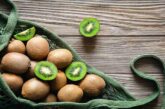
Acharya Kashyapa has instructed phalaprasana during 6 month of life, which indicates feeding the child with fruits and fruit juices. Introduction of cereals as semisolids i.e, Annaprasana has been explained by Kashyapa in the 10 th month or after eruption of teeth.” while Vagbhata and Susrutha has explained it in 6th month
As per WHO, the energy needs from complementary foods for infants with “average” breast milk intake in developing countries are approximately 200 kcal per day at 6-8 months of age, 300 kcal per day at 9-11 months of age, and 550 kcal per day at 12-23 months of age.
Acharya Kashyapa has suggested feeding of various fruits in the 6 month (Phalaprasana) which can be given as puree or in mashed form. By 8 months, most infants can also eat finger foods. And by 12 months, most children can eat the same types of foods as consumed by the rest of the family.
Foods that can cause choking such as nuts, grapes, raw carrots should be avoided. For small children, the food should not contain particulate matter that may trigger gag reflex or vomiting.
Healthy Alternatives For Packed Foods
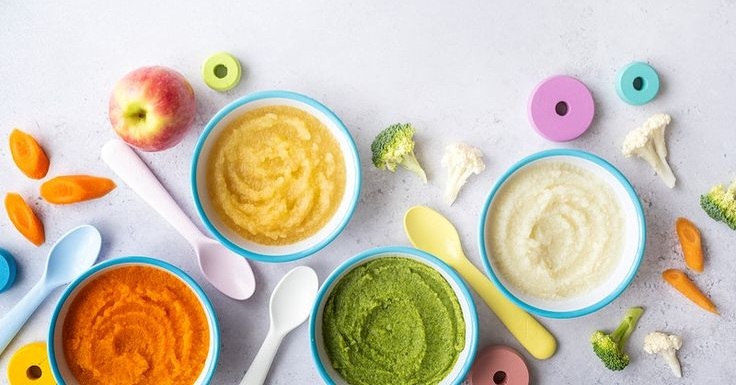
Below are some Ayurvedic alternatives and tips for newborn diets especially in summer, keeping their delicate digestion and body constitution in mind. Ayurveda emphasizes natural, gentle, and seasonal nourishment:
Draksha (Raisins) Water
द्राक्षा शीतला वृष्या मधुरा बलपुष्टिकृत्।
Draksha (raisin) is cooling, aphrodisiac, sweet in taste, gives strength and nourishment.
Soak 4–5 raisins in warm water overnight, mash in the morning, strain, and give the water. The cooling nature justifies Draksha water as a summer nutraceutical for infants. Ensure proper hygiene and avoid if child has diarrhea.
Bala Ghrita (Medicated Ghee)

घृतं मेध्यं बल्यं आयुष्यम् अग्निदीपनम्।
Ghee is intellect-promoting, strength-giving, life-supporting, and enhances digestive fire.
This supports the use of Bala Ghrita and medicated ghees in small quantities. A small drop can be added to weaning food (only after 6 months age).
Shatapuspa (Dill)
शतपुष्पा वातहरि बालग्रह नाशिनी।
Shatapushpa removes Vata and pacifies colic disorders in children.
While direct references for infants are limited, in Yogaratnakara and Kashyapa Samhita, Dill (Shatapushpa) is traditionally used in gripe water.
Ayurvedic Porridges
Shashtika Shali Peya (Rice Gruel): Acharya Charaka recommends Shashtika Shali (a type of red rice) as Balya (strength-promoting), Brimhana (nourishing), and Mridu (gentle).
Moong Dal Yavagu: Acharya Sushruta recommends Mudga (green gram/moong dal) for its Laghu (light) and Pachaka (digestive) properties.
Ragi Kheer (Nachni Porridge): Ragi is known in Ayurveda as cooling and Balya, excellent in summer. Make sure to use ragi flour and not the wholesome ragi to make it easy for baby to digest.
Acharya Kashyapa has mentioned that after 12th month, child should be fed with gruels prepared with husk free Sali and Shashtika rice,mixed with oleaginous substances and salt. Rice(Oryza sativa) is rich in carbohydrate and also contains vitamins and minerals like Iron, Zinc, Calcium etc.
It is a good promoter of nourishment and is easily digestible. Godhuma(Wheat) and Yava(Barley) powders can be cooked and given to the child according to congeniality. Godhuma( Triticum aestivum) contains carbohydrates, proteins, fatty acids, minerals etc and has body nourishing and immunomodulatory actions.
Modaka (sweet balls)
Acharya Vagbhata has prescribed various nutritional supplements in the form of Modaka (sweet balls) to cope up with the nutritional deficiencies and other gastrointestinal related disorders arising during weaning period. These are preparations specially developed to meet the nutritional needs of the infant as the usual family diets in our country are often inadequate for proper growth of the child.
Priyala Majjadi Modaka: This weaning food can be used for improving infant’s nutritional status and is prepared by using powders of priyala majja (Buchanania lanzan), yasthimadhu (Glycyrrhiza glabra), laja (rice pops), sitopala (sugarcandy) and madhu (honey). It is easily palatable and is rich in nutrients. It is called as Preenana Modaka.
Dhatkyadi modaka: It is prepared with Dhatakipushpa (Woodfordia fruticosa), Sharkara (sugar candy) and Laja(rice pop) and is good in children who suffers from repeated attacks of diarrhoeal disorders as it is having antihelminthic, constipating, anti bacterial properties. It is known as Samgrahi modaka.
Bala Vilvadi Modaka: It is indicated in infants with weak digestive capacity. It is prepared with Bala Vilwa (Unripe fruit of Aegle marmelos) Ela (cardamom), sharkara (sugar candy), laja saktu (rice pops). It is called Deepana modaka. In all the three nutritional supplements, the ingredients have good nutritional value in addition to their medicinal properties. Adding ghrita (Ghee) and jaggery will again increase the caloric value making them energy dense food.
General Guidelines (from Acharya Kashyapa & Charaka)
- Introduce one food at a time (called Satmya Pariksha: testing suitability).
- Begin with thin consistency and gradually thicken.
- Maintain clean, sattvic, fresh preparation each time.
Keeping Ayurvedic principles in mind infant foods have to be formulated considering current availability, acceptability, nutritional status and cost effectiveness of ingredients. Make sure to keep your baby away from packed food items as much as possible. Due to their constitution and use of harmful substances it gradually leads to hepatic poisoning as liver has to digest whatever the body consumes. It is advisable to choose Ayurveda for your infant to prevent them from fatal health problems in future because what you eat is what you become!