
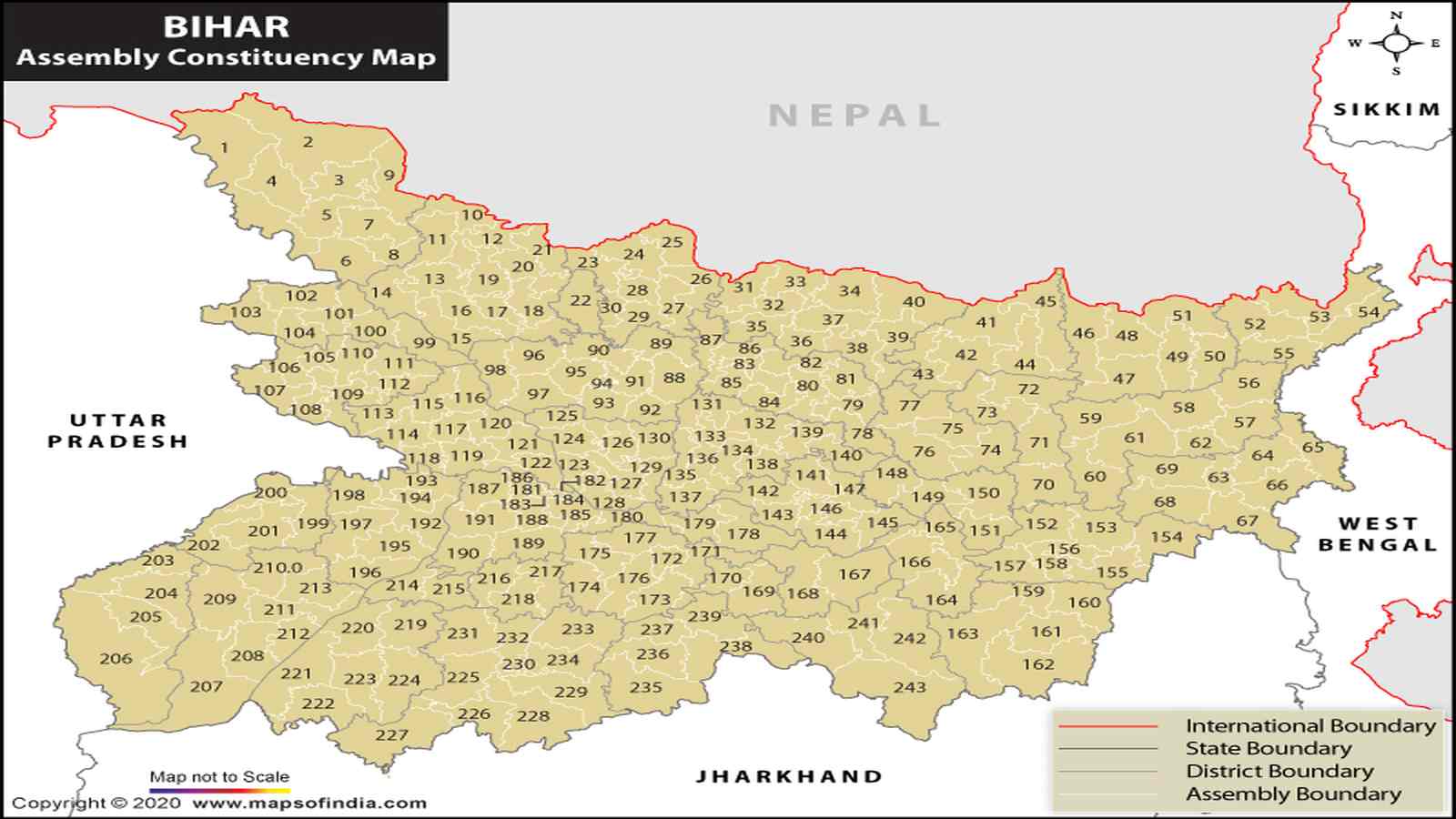
Belaganj Assembly Constituency 2025: Belaganj is Assembly Constituency No. 232 in the Gaya district of Bihar. It falls under the Gaya Lok Sabha seat. The constituency is General (unreserved). After the delimitation (c. 2008-09), Belaganj block plus much of the Gaya Sadar block form its territory.
Geography, Voters and Local Issues
Demographically, Belaganj is largely rural. Urban voters form a small minority. The Scheduled Caste (SC) community is significant, making up roughly 29.6% of the electorate; Muslims are roughly 15.8%. Voter registration has been increasing: in 2020 there were about 276,878 registered voters; by the time of the 2024 Lok Sabha polls it had risen to ~ 286,200.
Key local issues include:
- Agriculture: Being a predominantly rural area, issues of irrigation, farm inputs, prices matter a lot.
- Infrastructure: Roads, drinking water, public health, and connectivity to Gaya and other nearby urban centres.
- Social services: Education and literacy are somewhat lower, especially female literacy.
- Representation: With large SC and minority populations, candidate identity, caste dynamics and party ties are important.
Belaganj Assembly Constituency 2025: Recent Political History
Belaganj has seen dominance by the Rashtriya Janata Dal (RJD) for many years, especially since the 1990s, with Surendra Prasad Yadav being a repeated winner.
However, there was a shift in November 2024, when a by-election was held because Surendra Prasad Yadav moved to the Lok Sabha. In that by-poll, Manorama Devi (JD(U)) won, defeating RJD’s Vishwanath Kumar Singh by about 21,391 votes, thereby breaking RJD’s consecutive winning streak. This marked the first time in recent years that JD(U) captured the seat.
Election Numbers (2010–2020)
Looking at the past three full assembly elections (2010, 2015, 2020), here are the key figures:
2010: Surendra Prasad Yadav (RJD) won with ~ 53,079 votes; his nearest rival, Mohammad Amzad (JD(U)), got ~ 48,441. Margin was small. Vote shares were roughly RJD ~ 44%, JD(U) ~ 40%.
2015: Surendra Prasad Yadav (RJD) won with ~ 71,067 votes. The runner up was Sharim Ali (HAM), with about 40,726. RJD’s vote share was near 49%.
2020: Surendra Prasad Yadav again won (RJD), polling ~ 79,708 votes vs Abhay Kumar Singh (JD(U)) ~ 55,745 votes. Margin was larger, RJD nearly 47% share.
Barari Assembly Constituency 2025: Full Candidate List, Poll Date, Past Results and Winning Margins
Belaganj Assembly Constituency 2025: Past Complete Winners List
1977: Bipin Bihari Sinha (Janata Party)
1980: Ram Sewak Singh (Janata) / JNP(S)
1985: Ram Sewak Singh (LKD)
1990: Surendra Prasad Yadav (RJD)
1995: Ashok Kumar (Janata Dal)
2000: Surendra Prasad Yadav (RJD)
2005 (twice; two elections that year): Prem Kumar (BJP) in one; another result (details are more complex)
2010: Surendra Prasad Yadav (RJD)
2015: Surendra Prasad Yadav (RJD)
2020: Surendra Prasad Yadav (RJD)
2024 (By-election): Manorama Devi (JD(U))
Belaganj Assembly Elections 2025 Voting Date
Belaganj is voting today (11.11.2025) as part of Bihar’s second phase of polling.
Belaganj Assembly Elections 2025 Result Date
The Election Commission of India (ECI) has set 14.11.2025 as the date of results for the Belaganj constituency, along with the polling result of all Bihar Assembly seats.
Belaganj Assembly Elections 2025 Candidates List
| Party | Candidate Name |
|---|---|
| AAP | Madhumala Kumari |
| Bharatiya Sampuran Krantikari Party | Md. Abdullah |
| JD(U) | Manorma Devi |
| Jan Suraaj Party | Md. Shahabuddin |
| Peoples Party of India (Democratic) | Krishna Prasad Singh |
| RJD | Vishvanath Kumar Singh |
| Samajwadi Lok Parishad | Richa Jha |
| The National Road Map Party of India | Taravej Alam |
| INDEPENDENT | Lalu Yadav, Md. Istiyaque Ahmad, Rahul Ranjan, Vibhuti Narayan Singh |
What to Watch During the 2025 Contest?
1. Incumbency of JD(U): Manorama Devi winning the 2024 by-election implies that JD(U) is concentrating its efforts to strengthen its power. Will voters see her as someone who has delivered enough within the short time to keep their loyalty, or will RJD’s legacy be such that it will pull people back?
2. Caste and Community Dynamics: An SC neighborhood with a high population, a Muslim minority of noticeable size, and rural inhabitants in general seem to indicate that caste identity, community outreach, and candidate selection along those lines have the power to determine the results of close races.
3. Party Unity and Local Leadership: The issue of local community, however, is who can organise on the ground (party cadres, local leaders) to solve the problem. Whether RJD, JD(U), BJP etc manage their local leadership well or not, it may have a great impact on their vote share.
4. Development vs Welfare Promises: The constituency’s requirements (irrigation, roads, schools, and health) indicate that voters are most likely to assess performance through visible results: water supply, road connectivity, health services, and support for agriculture. Campaigns that more heavily rely on welfare or subsidy schemes in which they can gain support maybe will be successful.
5. Impact of the State & Alliance Politics at Large: Bihar politics is not a one-man show but instead, it involves alliances (NDA, etc.). The manner, why these components are not only (like JD(U), BJP) close relationships, but also RJD/others in agreement are even at the local level of politics, i.e., seat sharing as well as local-level cooperation, shall become the significant factor.