
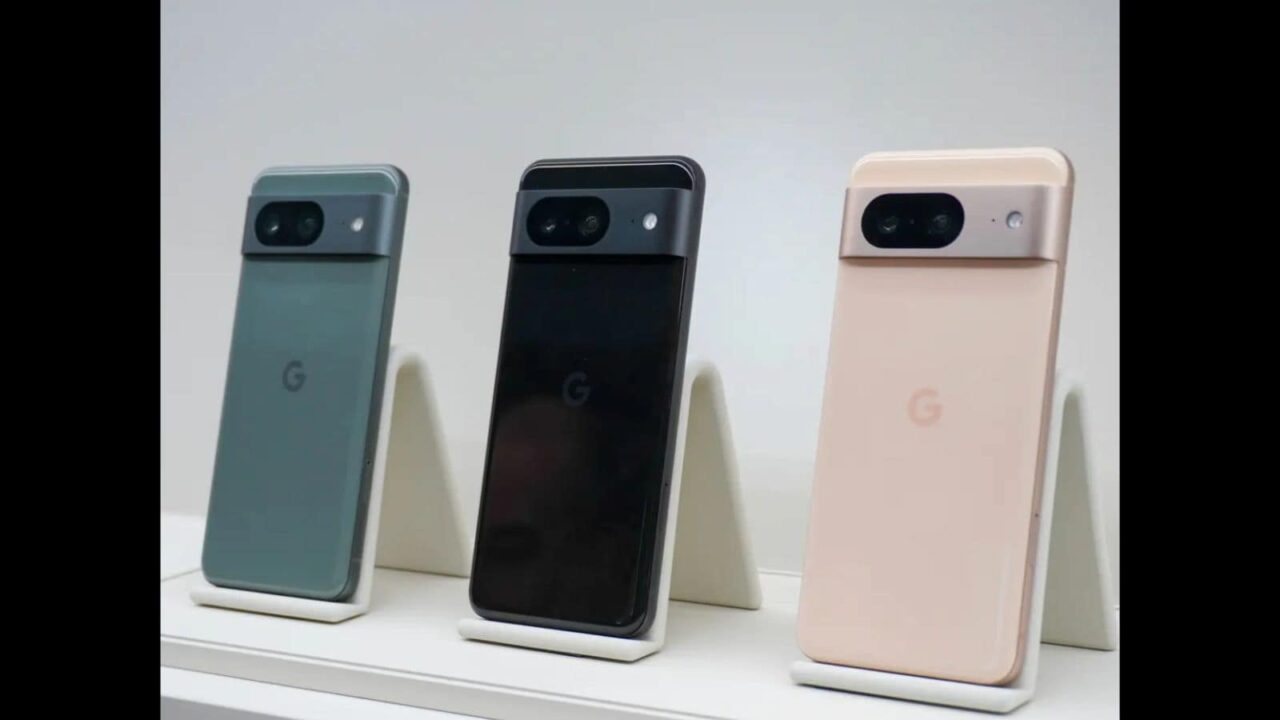
Google Pixel 8: Almost certainly, anyone who has visited similar tourist destinations or the leaning Tower of Pisa in Italy has attempted to capture the archetypal photograph of someone holding the tower aloft. You must position yourself at precisely the right distance and angle in order to execute this shot flawlessly. Additionally, this may necessitate multiple attempts to acquire the ideal image.
You might never again be required to endure this type of (first-world) difficulty, owing to Google. You will likely only require one photo, as the Magic Editor, an artificial intelligence-powered tool developed by the tech behemoth, is now accessible in Google Photos on the Pixel 8 and Pixel 8 Pro.
The Magic Editor employs generative AI in conjunction with AI processing techniques to enable non-experts to effortlessly modify complex photographs. While lightening and enhancing photographs is a component, it does more than that. In the case of the photo of the Leaning Tower of Pisa, you could reposition yourself, enlarge the tower, eliminate strangers in the background, and even fill the backdrop.
But why remain at that? Google claims that even the color of the atmosphere can be altered at will.
“If you’re trying to get the perfect photo from your time at a popular waterfall, you could remove the bag strap you forgot to take off,” said CEO Sundar Pichai, who first unveiled the feature in Google’s developer conference in May.
Additionally, Pichai suggested adjusting the sky’s brightness and decreasing the amount of cloud cover. “As a finishing touch, realign and adjust the scale of your subjects so they are precisely aligned beneath the waterfall.”
Pichai claims that each month, 1.7 billion images are modified on Google Photos. Implementing an AI-driven editor that enables users to rapidly modify any photograph is both a logical progression and a strategic marketing move.
“As a consumer, I am really excited about these new tools — there are so many times when I wish I could edit my images a little bit, especially when I take pictures of my little kids and they have a hard time standing still and looking at the camera,” said Anton Korinek, professor of economics at the University of Virginia Darden School of Business and a researcher at the Oxford Center for the Governance of AI.
Google Pixel 8 Pro Sets New Smartphone Standards: Revolutionary Features
Undoubtedly, The Magic Editor presents intriguing prospects for photo modification; however, it also prompts inquiries regarding the genuineness and reliability of images found on the Internet. The new Pixel phones from Google highlight both the potential and the dangers of artificial intelligence. One advantage is that it provides individuals with novel and convenient avenues to convey themselves through digital media. On the other hand, it has social implications, such as normalizing individuals’ online presentation of idealized versions of themselves. Even more alarmingly, it may present significant risks to individuals’ already delicate confidence in online content.
What would occur if an individual manipulated their professional photographs with the Magic Editor in a manner that misled others? What if it were to be utilized to spread propaganda or bogus news? How would one feel if it were used to alter or eliminate memories or history? How can we have faith in the content of social media when it is so readily altered by AI?
It is widely recognized that photographs can be altered through the installation of applications like FaceTune or Photoshop. Such has been the case for quite some time, and it has generated its own set of consequences. However, the Magic Editor transforms a task that formerly required several hours on a platform like Photoshop into an incredibly straightforward process, essentially placing the task at your fingertips. To modify the dimensions of an individual, for example, simply pinch the element; to reposition it, simply touch and drag.
Beyond Pixel 8 AI: The Magic Editor
To be fair, the capabilities of the Magic Editor on the Pixel 8 series are presently limited. In his Pixel 8 review, CNET Managing Editor Patrick Holland evaluated the modifying tool on a handful of images. In the span of a few seconds, he utilized Google Photos to alter the flooring from astroturf to brick after removing a massive boulder from the ground for one image.
Nevertheless, he reached the conclusion that the majority of the photographs produced by the Magic Editor contain imperfections, and the tool is presently in a more experimental stage compared to others that Google introduced on the Pixel 8.
The Pixel 8 ships with a suite of AI features intended to improve the daily lives of its owners, in addition to the Magic Editor. An update was made to Call Screen, the function through which Google Assistant answers calls on your behalf in an effort to protect you from robocalls and fraudsters. The Assistant can now comprehend a greater amount of call context and its voice now sounds more genuine.
The Audio Magic Eraser employs artificial intelligence to automatically remove unwanted sounds from recorded videos. But perhaps most significantly, Best Take was added. This artificial intelligence tool enables face swapping from a series of photos, allowing you to create an image in which everyone is smiling and staring at the camera, if that is what you desired.
The acceptance of counterfeit content
Disinformation and false imagery are already widespread issues that afflict numerous social media platforms. Facebook, Twitter, and TikTok have faced criticism in recent years for facilitating the dissemination of inaccurate or misleading content on their platforms, most notably throughout the COVID-19 pandemic and the 2020 United States presidential election. Certain platforms have implemented measures to identify and eliminate such content. However, legislators and users have reacted negatively to them, accusing them of censorship or bias.
“From a public policy point of view, there is no question that these tools [Magic Editor] will make it easier to produce disinformation by malicious actors,” said Korinek. “I don’t know the technical details yet, but I do hope that Google will add watermarks to images that have been edited to make it easier to verify what’s fake and what’s real.”
Should I anticipate that the Magic Editor will be the target of a disinformation campaign comparable in scale to those that raged during the presidential election? Most likely not.
However, Google is facilitating the proliferation of fabricated content on the internet by providing native modification tools with the capability to generate an image that is diametrically opposed to the original. Google is not only providing us with the means to perfect reality, but it is also legitimizing the practice. I wish we didn’t live in a world where every photograph can be altered or manipulated in an instantaneous manner.