

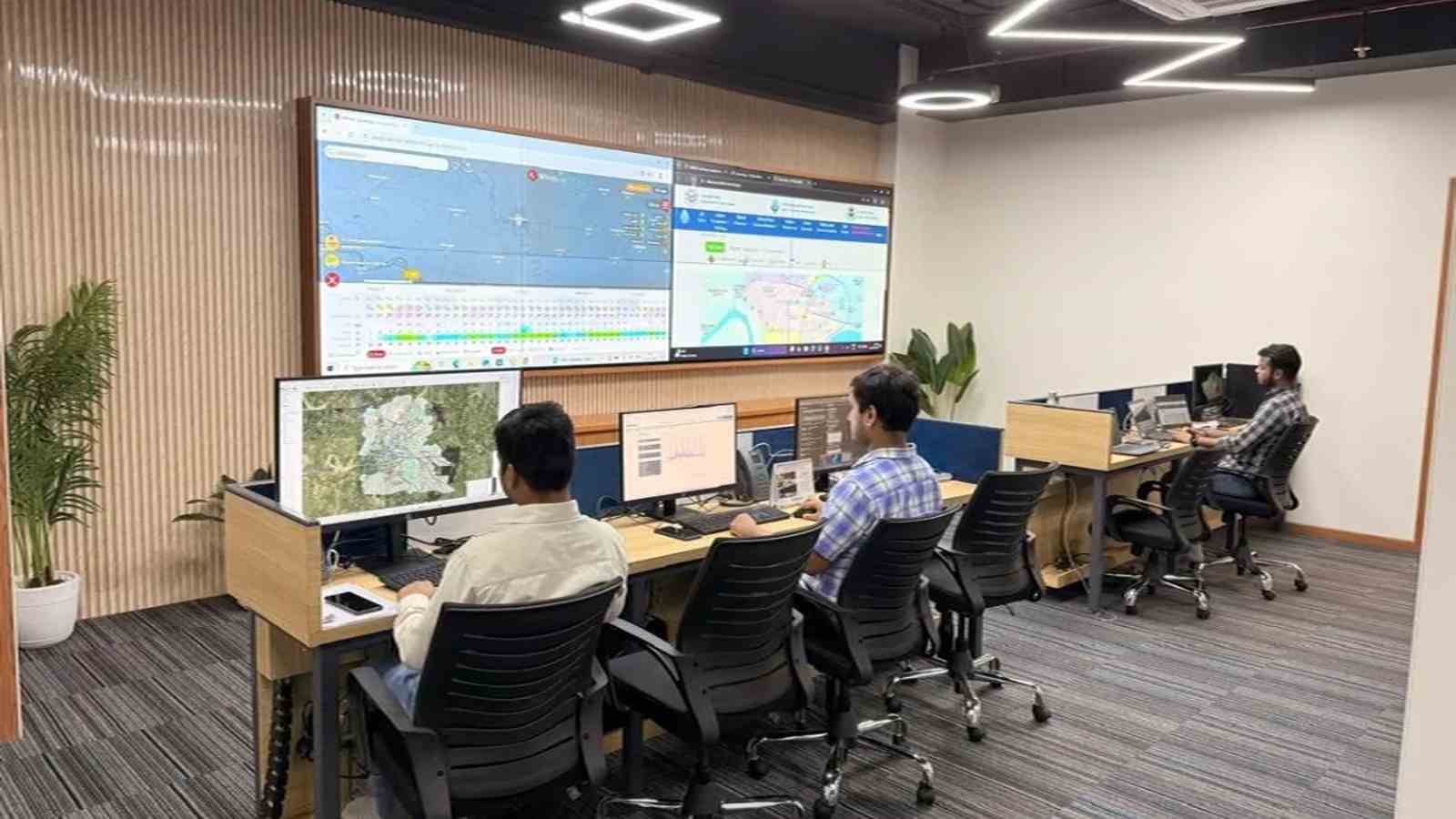
Gorakhpur Flood Management 2025: Gorakhpur has long grappled with waterlogging during heavy rains leaving roads submerged, traffic halted and residents stranded. Now, the city’s Urban Flood Management Cell (UFMC), under the Gorakhpur Municipal Corporation, has been given national-level support: the National Disaster Management Authority (NDMA) has in-principle approved aid of ₹750 crore for a major upgrade.
This isn’t just a local fix, it signals a shift in how mid-sized cities are gearing up for climate-driven risks, combining infrastructure, technology and natural solutions.
In the first phase, ₹220 crore has been sanctioned with 90 % borne by the Centre and 10 % by the state government.
Gorakhpur Flood Management 2025: Key features
Expansion of automatic rain gauges (ARGs) from currently 2 to between 15–20 across the city to assess rainfall in real time.
Installation of automatic water level recorders (AWLRs) along medium and large drains enabling scientific monitoring of rising water during monsoon.
Adoption of “Blue-Green Infrastructure” development: rather than purely concrete solutions, emphasis on natural materials, wetlands conservation (areas like Mahesra, Chilua Tal, Ramgarh Tal, Sumer Sagar) and natural treatment methods for discharge water.
Preparation of a Detailed Project Report (DPR) by the Municipal Corporation, to be submitted to NDMA as part of the funding process.
How is Gorakhpur already a model?
The UFMC in Gorakhpur has already been recognized by its peers: in September 2025, a state-level conference of nine other municipal corporations came to Gorakhpur to study this model.
Earlier, reports indicated the city would become the first in Uttar Pradesh to deploy a fully integrated urban flood‐control system blending real-time sensors with on-ground execution.
Patna-Gorakhpur Vande Bharat Set for Launch on June 21: PM Modi to Inaugurate
What residents should watch out for?
1. With these upgrades, even when it pours, you’ll probably see fewer disruptions. Water won’t stick around as long, and teams can jump in faster when things go wrong.
2. With this new technology, the city is able to deliver alerts and share information with the public in real-time. The people get the alert about the problem before it escalates, and thus, everyone can help in the situation by reporting the places that are flooded.
3. Just the initial round of financing has been released, so the complete transformation will be later. Meanwhile, yes, you might see a little more construction or a few temporary inconveniences.
4. It’s not just about more drains and concrete. The proposal brings in trees, conserves the wetlands, and maybe even creates new parks and open areas that become reservoirs for water.
As a result of climate change, which makes rain more unpredictable, cities such as Gorakhpur are exposed to greater risks of flash floods and waterlogging. In the past, slow drain cleaning, old-fashioned designs, and a lack of sensors made the city respond slowly. This new UFMC upgrade is a game-changer.