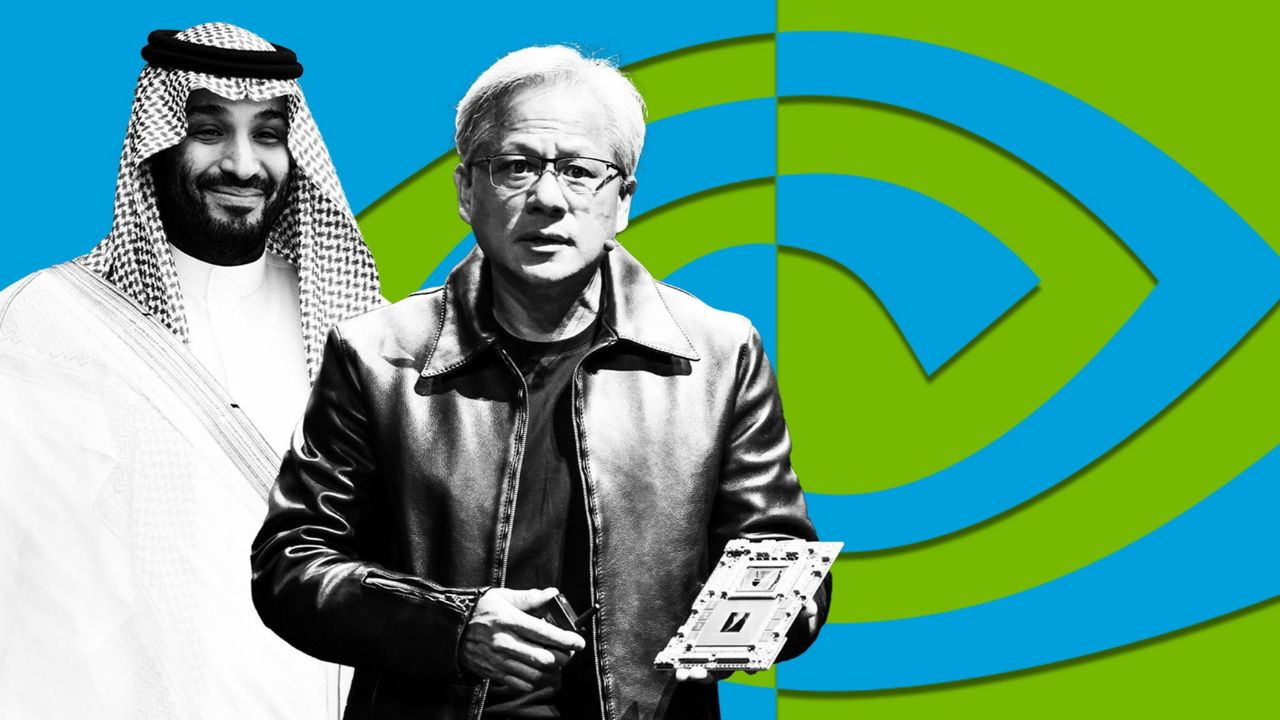
Saudi Arabia and UAE Intensify Chip Wars to Dominate the AI Race: Saudi Arabia and the United Arab Emirates are acquiring large quantities of high-performance Nvidia processors, which are indispensable for the development of artificial intelligence software.
This action positions them among the nations competing in the global AI competition, which is straining the availability of Silicon Valley’s most in-demand commodity: semiconductors.
How Saudi Arabia and the United Arab Emirates have joined chip warfare
As part of their endeavours to diversify their economies, both Saudi Arabia and the United Arab Emirates have previously, albeit independently, expressed their desire to become AI leaders.
However, reports in western media indicate scepticism regarding the potential misuse of AI technology by their autocratic leaders.
According to reports, Saudi Arabia has purchased more than 3,000 Nvidia H100 processors, which are valued at $40,000 each.
These chips, which Nvidia’s CEO Jensen Huang characterised as “the world’s first computer chip designed for generative AI,” were acquired from the research institution King Abdullah University of Science and Technology (Kaust).
The UAE has access to a considerable number of Nvidia chips and has developed its own open-source large language model, known as Falcon, at the Abu Dhabi Technology Innovation Institute, which is owned by the government.
Both nations are investing strategically in computing capacity and talent to reduce their dependence on other global powers. These efforts have been facilitated by their vast resources and ability to recruit top talent.
Saudi Arabia and UAE Intensify Chip Wars to Dominate the AI Race: What does the Saudi Arabia and UAE chip conflict mean?
Saudi Arabia and the United Arab Emirates’ purchases of Nvidia processors align with a broader global trend in which leading technology companies scramble to acquire scarce AI development chips.
Additionally, Chinese tech titans such as Tencent and Alibaba have sought to acquire Nvidia’s high-performance processors. However, their efforts have been hampered by the Biden administration’s restrictions on Chinese procurement of vital US-made technologies.
According to multiple sources close to Nvidia and its manufacturer Taiwan Semiconductor Manufacturing Company cited by the Financial Times, the chipmaker will distribute approximately 550,000 of its most recent H100 chips worldwide in 2023, primarily to U.S. technology companies.
UAE was the first nation to institute a ministry of AI
The United Arab Emirates established the first ministry of artificial intelligence in 2017. As part of Abu Dhabi’s “commitment to reinforcing its global position as a pioneer in technology and artificial intelligence sectors” and “regulatory frameworks to limit the negative use of technology”, the country has now released a “Generative AI Guide”.
Saudi Arabia and UAE Intensify Chip Wars to Dominate the AI Race: What is the conclusion?
Saudi Arabia and the United Arab Emirates both manage some of the largest and most potent sovereign investment funds in the world. Therefore, the two West Asian economic powers possess what many nations that aspire to head the AI race lack: financial strength.
According to reports, representatives of Gulf state-affiliated funds have contacted AI startups in the West in an effort to gain access to code and expertise in exchange for computing resources.
The Financial Times cites one of the chief executives of two European AI companies as saying, “We have received offers of enormous financings and access to data in order to indirectly tap into our talent.” The executive, who purportedly declined the offers, was quoted as saying the following.
During a visit to the region in June, OpenAI CEO Sam Altman lauded the UAE’s foresight in recognising the significance of AI. He stated that Abu Dhabi could “play a central role in this global conversation” regarding the regulation of the emerging technology.
“Artificial intelligence was discussed, in particular in Abu Dhabi, before it became trendy,” he said. “Now everyone is on the AI bandwagon, which we find exciting, but we have a special appreciation for those who were discussing AI when everyone believed it would never happen.”
Tesla Transfers Manufacturing of Battery Cells from Germany to the United States
But the United States is by far the leader in the chip conflict
According to the US government, a staggering $166 billion were invested in semiconductors and electronics in the first year.
In the United States, the CHIPS Act provides nearly $53 billion in incentives for semiconductor manufacturing, research and development, and workforce development. It further specifies a 25% tax credit for semiconductor manufacturing capital expenditures.
At least 50 community colleges in 19 states have announced new or expanded programming to assist American workers in gaining access to well-paying employment in the semiconductor industry.
The US Department of Commerce released the first round of CHIPS grants last week in an effort to promote the development of open and interoperable wireless networks.
In the meantime, the National Science Foundation and the Departments of Energy, Commerce, and Defence have taken collaborative steps towards establishing the National Semiconductor Technology Centre, one of the first of its kind in the world.