

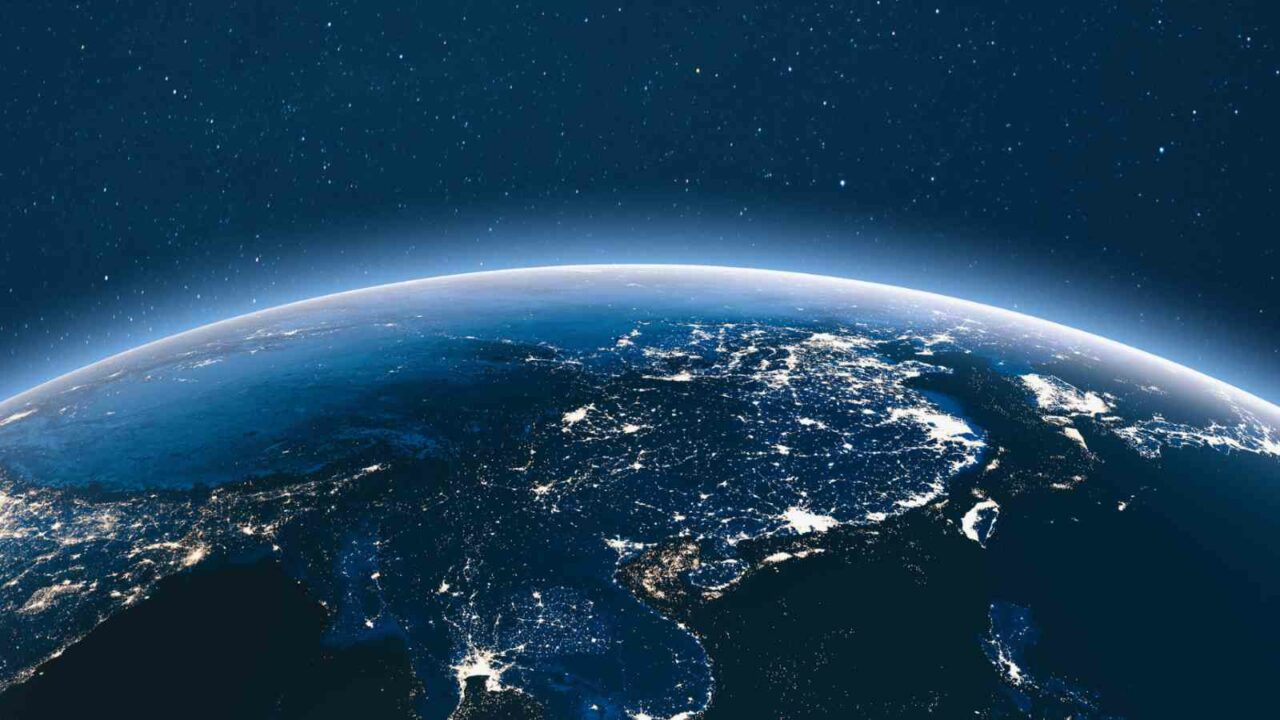
Earth’s Biggest Threats: Earth, the only home we know won’t last forever. Some big, dangerous things could happen that might end life on our planet. These dangers are not from silly internet trends but real, serious threats that scientists watch closely. Let’s look at the biggest ones and what they mean for us.
5 Earth’s Biggest Threats
1. The Sun Will Grow Huge and Burn the Earth
Is the Sun waking up again?
Eruptive X1.2 flare from AR 14086, the first X-class flare since March 28, 2025. This is associated with a CME that drives a weak shock wave responsible for a minor SEP event.
This video is AIA 211+304 to show both the shock and filament eruption. pic.twitter.com/pMIwVg6zEK
— Halo CME (@halocme) May 13, 2025
Our Sun, the big ball of fire in the sky, will one day stop using the hydrogen it needs to shine and keep us warm. When this happens, the Sun will get about 10% brighter. This extra light will make Earth’s water slowly disappear because the heat will break water molecules apart, and the hydrogen will float away into space.
Panic in Bangkok and Yangon: Central Myanmar Struck by 7.7 Magnitude Earthquake
After this, the Sun will swell up and turn into a red giant. It will grow so big it will reach out as far as Mars and swallow Earth whole. The good news is this won’t happen for a very long time about a billion years from now. Still, it’s a reminder that Earth’s days are not endless.
2. A Giant Meteor Could Crash and Wreck Everything
Long ago, a huge space rock hit Earth and caused the dinosaurs to disappear forever. Even now, big meteors fly through space, and one could hit us anytime. Scientists at NASA and other space groups are trying to find ways to stop dangerous rocks from crashing into Earth, but there is always a risk. If a big meteor does hit, the damage would be terrible.
At first, the impact would create a huge explosion. If you survive that, then powerful earthquakes, giant waves called tsunamis, and huge fires could follow. The air would fill with dust and smoke, making it hard for plants and animals to live. Food would be scarce, and many species could die off, just like the dinosaurs.
3. Volcanoes Could Cause Massive Disaster
Indonesia's Semeru volcano erupts in massive eruption, sending ash and pyroclastic flow engulfing nearby village
The author was only able to upload the video a week after the eruption because his phone was damaged by the ash. pic.twitter.com/cjZ22wUhJO— Black Hole (@konstructivizm) January 6, 2025
Surprisingly, volcanoes are one of the deadliest threats Earth faces. In the past, volcanic eruptions have caused the extinction of many species. When a volcano erupts, it doesn’t only shoot out lava and fire. It also sends dust, poisonous gases like sulfur oxides, and carbon dioxide into the air.
Nature’s Secret Giant Tree: 3,000-Year-Old Tree Discovered in Remote Forest of Tanzania
These chemicals block sunlight, which plants need to grow. Without plants, the food chain collapses. The land and oceans get poisoned by acid rain, and the gases make global warming happen much faster. Volcanoes have caused 11 huge extinction events in Earth’s history, showing just how dangerous they can be.
4. Global Warming Could Make Earth Like Venus
Earth might one day become like Venus, a planet with a super-hot, thick atmosphere. Venus’s surface is around 465°C (869°F), much hotter than Earth. Its air is mostly carbon dioxide, and it has clouds made of sulfuric acid. The pressure there is 90 times stronger than on Earth, and the winds blow very fast. Scientists believe that past mass extinctions on Earth, like those that killed 75% to 96% of species, happened because of big global warming events. Right now, Earth faces rising temperatures because of greenhouse gases, mostly from humans. If this keeps up, Earth’s climate could become extreme, like Venus, making it impossible for life to survive.
5. Nuclear War Could Destroy Us All
If nature doesn’t end Earth, humans might. A nuclear war could bring about what people call “nuclear winter.” Author Annie Jacobsen described this in her book Nuclear War: A Scenario.
She said, “With all of these explosions, 330 billion pounds of soot gets lofted into the troposphere. That is enough soot to block out 70 percent of the sun, creating a dramatic temperature plunge up to 40 degrees Fahrenheit, certainly in the mid-latitudes.”
This means much of the world would get very cold, and places like Iowa or Ukraine could freeze over with ice. The cold would kill crops, which people need for food. Without enough food, millions or even billions could die. Jacobsen estimates that about 5 billion people might perish from the aftermath of nuclear war.